
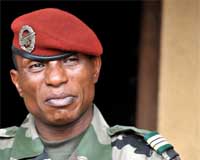
Guinea's junta celebrated its first year in power on Wednesday, but in the absence of its leader who is in Morocco for medical care after his aide de camp shot and wounded him.
The regime is also under mounting international pressure for alleged crimes against humanity after soldiers in September massacred at least 156 protesters in a Conakry stadium, according to UN investigators.
Hundreds of others were wounded and soldiers also systematically raped women and young girls.
The junta led by Captain Moussa Dadis Camara came to power in a bloodless coup early on December 23 2008, just hours after the announcement of the death of the west African country's strongman, Lansana Conte, from illness.
When they seized control, the putschists justified their action by saying they would fight "generalised corruption, impunity as a method of government and anarchy in the apparatus of the state" after Conte's 24-year reign.
But a year later, Guinea is plunged into economic, social and political chaos.
Most of the population wants the military to quit power and people fear further violence after the stadium bloodbath. The junta has banned street demonstrations and most opposition leaders have fled abroad.
"We are celebrating one year since taking power in a slightly difficult context, difficult in economic terms and difficult in social terms," Colonel Moussa Keita told Guinean national radio on Tuesday.
Keita, permanent secretary of the National Council for Democracy and Development (CNDD), as the junta calls itself, nevertheless announced small parties in military units and barracks, with parades and special meals.
Guineans have heard and seen almost nothing of Camara since he was shot in a Conakry military camp on December 3 by his aide, Lieutenant Aboubabakar "Toumba" Sidiki Diakite, who is now on the run.
The junta repeatedly broadcasts the same official message that Camara "is getting better and intends to return to Conakry as soon as possible," in the words of Guinea's ambassador to Morocco, Mamadouba Diabate.
The country is currently being run by defence minister General Sekouba Konate. And according to one source close to the regime, a minister recently told Konate that Camara was in "quite an appalling condition", unable even to feed himself.
"There will be nobody in the streets spontaneously to celebrate this anniversary," young opposition leader Mouctar Diallo told AFP from Dakar.
"The record of the junta is catastrophic, in terms of its management of public affairs and the very widespread military violence that culminated in the massacre in Conakry on September 28."
A UN inquiry panel ruled on Monday that the killing of government opponents by troops in September amounted to "crimes against humanity" and that the west African country's military rulers should be held responsible. It directly blamed Camara, among others.
"The details of the massacre (…) are very painful, even to read. This refinement of cruelty and torture, in particular against women, sends shivers down the spine," French Foreign Minister Bernard Kouchner said Tuesday.
"I hope that Mr. Dadis Camara remains in his bed in Morocco and that he does not return" to Guinea "because he would be capable of sparking a civil war," Kouchner told the French parliament.
The European Union on Tuesday decided to toughen sanctions against the junta by imposing a freeze on all funds and economic resources known to belong to its members.
The EU also banned any supplies to Guinea of equipment that could be used for purposes of internal repression.
Share This Article With Planet Earth
