
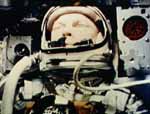
Washington, DC Jan. 17, 1998 – Saying his selection of Ohio Democratic Senator John H. Glenn, Jr. for a return trip to space wasn't the beginning of a new era of civilian spaceflight, NASA Administrator Daniel S. Goldin announced Friday he was expanding the U.S. astronaut corps to include flyers with new skills and unconventional new backgrounds.
Goldin announced that Glenn, a 76 year old politician and former Project
Mercury astronaut, would fly as the last Payload Specialist for NASA on the
STS-95 space shuttle mission now set for an autumn lift-off. But the NASA
space chief also announced the death of the Civilians In Space program, a
1984 Reagan administration project to fly teachers and non astronaut
researchers, scholars, and even journalists aboard the space shuttles. The
last civilian to fly under the program was schoolteacher Christa McAuliffe,
who died on Jan. 28, 1986 when the shuttle Challenger was destroyed in a
launch explosion.
McAuliffe's back-up teacher-in-space, Barbara Morgan, will get her chance,
after a decade's wait, to fly into orbit. But only under a new program
announced Friday by which she will, in fact, become a U.S. astronaut and
submit to the standard, extensive astronaut training program. Goldin said
that Morgan would eventually fly as a Mission Specialist on a shuttle or
space station mission. "She will do science on her flight," Goldin said.
"This will be her primary duties, in addition to teaching." The new
non-astronaut astronaut program would seek, in Goldin's words, to "find
biologists and chemists and others with different and varied backgrounds"
to become temporary astronauts. "There is no more civilians in space," he
added. "We want people with graduate degrees, trained in science and
technology, who have new ideas and reasons for their missions." The
candidates selected under the new program would have to undergo the same
extensive training that other astronauts have to experience. Earlier
civilians like McAuliffe went through slightly more than a year's worth of
training on average, and some, like former Utah Senator Jake Garn, who flew
aboard Discovery on a 1985 spaceflight, trained for less than a year.
In essence, however, the new program is another effort to bring civilians
aboard U.S. space vehicles that have not been part of the astronaut culture
of test pilot training or science researchers, the same goal as the
original 1984 project. A long time foe of such ideas, Goldin was defensive
when asked by SpaceCast about his "conversion" from critic to supporter,
especially in light of the Glenn decision. "I didn't change my view,"
Goldin said after the press conference. "I helped an American hero." And he
also claimed that politics had no part in his approval of Glenn's second
flight. "I felt it was the appropriate thing to do," Goldin snapped. "We
cannot hide from risk. ..but this is not a signal that the shuttle is safe
to fly civilians." It is, apparently, safe to fly politicians.
