
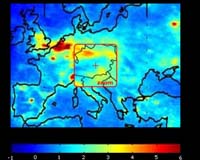
The international Earth Observation Summit on February 16, 2005 in Brussels is aimed at laying the foundations for a Global Earth Observation System of Systems (GEOSS) through the approval of a ten-Year Implementation Plan. The primary European contribution to the GEOSS is the Global Monitoring for Environment and Security (GMES) initiative.
Jointly led by the European Commission and ESA this initiative will bring together the capacity of Europe to collect and manage data and information for both environment and civil security purposes.
European countries are already in a position to bring space capabilities to GMES: ESA through the satellites Envisat or ERS (European Remote Sensing), France with the current Spot 4, Spot 5 and Jason satellites as well as the future Pleiades constellation, Germany and Italy with both radar satellites, respectively TerraSAR and Cosmo/Skymed.
January 6, the French Minister of Research, Francois d'Aubert, announced that some measures will be suggested to accelerate space projects dedicated to natural disasters warning. Finally, ESA will define an implementation plan for GMES by the end of the year.
MIDI-Pyrenees To Strenghten Its Competitiveness In The Space Field
Meanwhile, the space field represents 10 000 jobs in the French Midi-Pyrenees region, including 6500 in industrial companies and 2400 within CNES and its subsidiaries. The region plays thus a key role in space industry which has still to be strengthened.
The CNES centre of Toulouse has organised in January a workshop aimed at working out a strategy to improve the region's attractiveness and ensure its economic growth. The adopted strategy will be mainly based on the following points: developing the sector of boarded systems, establishing closer bounds between space research and industry, organizing space students' projects, increasing the number of foreigners, and implementing several measures to facilitate access of new entities to space markets.
Among others objectives, one is to install in Toulouse a technical centre dedicated to satellite navigation activities and the Galileo concession.
