
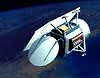
Orbital Sciences Corporation announced today that it is prepared to launch the U.S. Navy'sGEOSAT Follow-On (GFO) satellite and two ORBCOMM communications satellites aboard its Taurus(R) rocket early next week. The GFO/ORBCOMM launch will be the second mission for Orbital's ground-launched Taurus vehicle, which is a four-stage derivative of the company's Pegasus(R) space launcher. The mission will originate from Vandenberg Air Force Base (VAFB), California, and is subject to final preparations and testing, as well as acceptable weather conditions at the launch site.
Orbital also announced that the next launch of its Pegasus rocket,
originally scheduled for late this week, has been delayed by the poor weather
conditions on the West Coast that are forecasted to continue for the next
several days. The combination of the inclement conditions and a busy launch
schedule from VAFB facilities is expected to result in a new Pegasus launch
date after the Taurus mission.
On launch day, the Taurus rocket will be prepared for its mission during a
four-hour countdown procedure. The vehicle will then ignite its first stage
rocket motor, lift off and follow a preprogrammed launch sequence controlled
by its on-board flight computer. Taurus will first deliver the GFO satellite
into its planned polar orbit at an altitude of 779 by 790 kilometers inclined
at 108 degrees. The rocket will then release the two ORBCOMM satellites into
approximately the same orbit. The launch is scheduled to occur at
approximately 7:00 a.m. Pacific time on Monday (February 9), with another
available opportunity at the same time on Tuesday (February 10). The launch
window extends from approximately 5:00 a.m. to 7:35 a.m. on both days. Due to
the trajectory of the Taurus rocket, initial communications with the GFO and
ORBCOMM satellites are not expected to be established for several hours after
their release from the launch vehicle.
The Taurus Launch System
Orbital developed the ground-launched Taurus vehicle to provide a cost-
effective, reliable means of launching satellites weighing up to 3,000 pounds
into low-Earth, or up to 800 pounds into geosynchronous Earth orbit. Taurus
incorporates advanced structural and avionics technology proven on Pegasus and
other operational launch systems and is designed for easy transportability,
offering customers rapid-response launches from a wide range of locations.
The first Taurus launch occurred in March 1994 and placed two U.S.
Department of Defense satellites precisely into their target orbits. Since
then, Orbital has developed an upgraded Taurus vehicle to meet the need for
greater performance and payload volume. The vehicle being used for the
GFO/ORBCOMM mission has several different features compared to the original
Taurus configuration, including a larger payload fairing (92 inch versus 62
inch diameter) and a more powerful first stage, the commercial Castor 120
motor built by Thiokol Corporation [NYSE:TKC – news].
The GFO Satellite
The 813 lb. GFO satellite was built by Ball Aerospace & Technologies Corp.
for the U.S. Navy's Space and Naval Warfare Systems Command. The satellite
will use a radar altimeter and a water vapor radiometer to precisely measure
the subtle differences in sea surface height associated with ocean currents
and eddies. The altimeter will also provide information about wave height and
sea and glacier ice. GFO will transmit this oceanographic information
directly to ships at sea and to Navy facilities on shore. The data from the
mission is intended to enhance the effectiveness of Navy weapon and sensor
systems.
The ORBCOMM Satellites
The two ORBCOMM satellites to be launched aboard Taurus will bring the
total number of satellites in the low-orbit constellation of data
communications satellites to 12. The first two satellites were launched on a
Pegasus rocket in April 1995, followed by a recent launch of eight more on
another Pegasus in December 1997. Twenty-four more ORBCOMM satellites are
currently in production at Orbital's Germantown, Md. satellite manufacturing
facility.
The ORBCOMM satellites are based on Orbital's flight-proven MicroStar(TM)
spacecraft platform. After the first launch in 1995, Orbital took advantage
of the latest technology to make the newer models even more robust and durable
than the original versions. These satellites incorporate improvements that
will increase their on-orbit life as well as expand ORBCOMM's overall system
capacity. At the same time, Orbital's use of new materials and components has
allowed the weight of each satellite to be reduced by 10% to approximately 90
lbs.
Following the launch, the two ORBCOMM satellites will undergo standard
spacecraft checkout procedures to ensure that they are operating as planned,
as well as to make adjustments to their orbital positions using small onboard
thrusters. Like the first two ORBCOMM satellites, which were also launched
into a polar orbit, these satellites will increase total communications system
coverage over the higher latitude regions of the Earth. The satellites are
expected to be placed into commercial service about 90 days after launch.
The ORBCOMM Network
ORBCOMM Global, L.P. is a partnership of Orbital, which owns 50% of the
company, Teleglobe Inc. [NYSE:TGO – news] of Canada and TRI Inc. of Malaysia. ORBCOMM is the
world's first mobile satellite services provider offering two-way data and
messaging communications globally through a network of international service
licensees, covering over 90 countries, and in North America through more than
35 value-added resellers and direct sales channels. It is fully licensed by
the U.S. Federal Communications Commission and is currently providing
communications services in the U.S. and Canada. It has also been granted
spectrum worldwide by the International Telecommunications Union.
Applications for ORBCOMM's data and messaging services include mobile
industrial asset tracking and fixed-site monitoring. With its two operational
satellites that were launched in 1995, ORBCOMM currently offers global data
communications services to customers in the transportation, marine, oil and
gas, utility, heavy equipment and defense-related industries. As more
satellites are deployed and the system's coverage increases, ORBCOMM expects
to develop applications for the two-way personal messaging and paging markets.
ORBCOMM maintains its corporate and administrative offices, as well as its
state-of-the-art Network Control Center, in Dulles, Va., approximately 30
miles outside of Washington, D.C. It currently operates four gateway ground
stations in the U.S., and is constructing and activating additional ground
stations in Europe, Asia, Africa and South America this year.
About Orbital
Orbital is one of the ten largest space-related companies in North
America, with 1997 sales of over $600 million and a work force of 4,000
people. The company is the world's leading manufacturer of low-cost space
systems and products. Through its ORBCOMM and ORBIMAGE subsidiaries, Orbital
is also a pioneering operator of satellite networks that provide
communications and imagery services to customers all around the world.
Since its founding in 1982, Orbital (including several predecessor
companies) has built and launched, or now has on order, nearly 350 small- and
medium-class satellites and small launch vehicles. It has also produced over
15,000 space-related sensors and electronics systems and has installed
satellite ground stations in more than 25 countries.
The company's Magellan subsidiary is the world's premier producer of
mobile satellite access products. Magellan offers the broadest line of
products that use the Global Positioning System (GPS), from hand-held consumer
models that retail for $99 to advanced technology, high-precision units for
industrial and scientific uses. Using GPS and other technologies, Magellan's
PathMaster(TM) is the most popular satellite-based car navigation system in
the U.S., with over 10,000 units installed. In addition, Magellan produces
state-of-the-art satellite communications products, including satellite
telephones and hand-held personal messaging units for the ORBCOMM network.
Finally, Orbital is now building a strong position in the rapidly growing
market for satellite-delivered services. In addition to ORBCOMM's data
communications services, Orbital's ORBIMAGE subsidiary is offering
satellite-based Earth imaging services worldwide with two operational
satellites, OrbView-l and -2, and with the OrbView-3 and -4 high-resolution
digital imaging satellites expected to be in service in 1999 and 2000,
respectively.
