
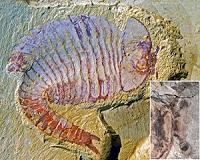
Esben Horn, a Danish artist, is helping Swedish geologist Mats E. Eriksson and his colleagues to imagine the world of Agnostus pisiformis, the tiny trilobite-like arthropod that proliferated throughout Scandinavia during the Cambrian period, some 500 million years.
Though prolific, Agnostus pisiformis thrived for only a brief period of time, making the fossil useful as a time reference. And though quite small — and seemingly delicate — Agnostus pisiformis fossils preserve well.
An abundance of fossilized soft tissues have allowed scientists like Eriksson to model the arthropod's insides, and for artists like Horn to create life-life sculptures of the species.
"The sculptures have been greatly scaled up and show the animal's complete anatomy down to the smallest detail, including all the extremities and antennae," Eriksson, a geology professor at Lund University, said in a news release.
In addition to its usefulness as a time reference, Agnostus pisiformis also offers scientists insights into how life developed during the Cambrian period, as Scandinavia's wealth of fossils have preserved the arthropod's development from juvenile to mature adult.
For their latest project, Horn and Eriksson tried to imagine the miniature world of the Agnostus pisiformis in the form of larger-than-life sculptures. They detailed their efforts in a new paper, published this week in the journal Earth-Science Reviews.
"The incredible degree of preservational detail means that we can grasp the entire anatomy of the animal, which in turn reveals a lot about its ecology and mode of life," Eriksson said.
Volcanic carbon dioxide drove ancient global warming event
New research, led by the University of Southampton and involving a team of international scientists, suggests that an extreme global warming event 56 million years ago was driven by massive CO2 emissions from volcanoes, during the formation of the North Atlantic Ocean.
The study, published in Nature, used a combination of new geochemical measurements and novel global climate modelling to s … read more
