
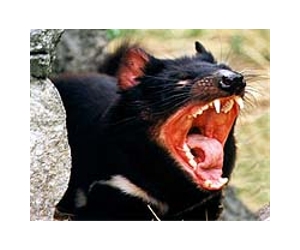
Australian scientists Thursday said they had made a breakthrough in the fight to save the cancer-hit Tasmanian devil by mapping the species' genome for the first time.
The dark, furry marsupials were declared endangered in 2009 after a contagious cancer began sweeping through the population, disfiguring their faces so badly they are unable to eat and starve to death.
Some 70 percent of devils have already been lost to the infectious disease, which is spread by biting as the feisty creatures mate and fight over animal carcasses.
But researchers working to save the dwindling species said the genome sequence opened a new path to understanding where the cancer attacked and how it could potentially be treated.
"This sequence is invaluable and comes at a crucial time," lead researcher Elizabeth Murchison said.
"By comparing our draft sequence with samples taken from many hundreds of devils suffering from this cancer, we can begin to look at the spread of the disease… by identifying geographical routes and barriers in its transmission," she added.
"This knowledge could ultimately shape the ongoing conservation efforts in Tasmania."
Murchison said the information would allow scientists to identify which mutations had actually caused the devils' cancer "and perhaps allow us to target those mutant genes with particular drugs".
But Murchison, from the Australian National University, stressed the map was just the first step on what was likely to be a long and difficult road.
"Cancer is caused by a number of quite random mutations that occur in the genome. Actually finding out which ones of those cause the cancer is quite a challenge and something that we still have ahead of us," Murchison told ABC radio.
Scientists believe the cancer could wipe out the entire wild population of devils within 20 to 50 years, and experts have been capturing and breeding healthy animals in zoos for past six years to develop a buffer group.
Their work suffered a setback last month when a devil thought to be immune to the cancer, Cedric, died in captivity, dashing hopes scientists were nearing a cure.
Tasmanian devils first came to prominence when their unearthly shrieks and grunts while devouring animal corpses terrified European settlers arriving in Tasmania in the 19th century.
Some 150 years later, the devil has been made famous by "Taz", a Warner Brothers cartoon character that now fronts the conservation campaign to save the species.
earlier related report
China experts arrive in Japan to probe panda death
Tokyo (AFP) Sept 16, 2010 –
A team of Chinese experts arrived in Japan Thursday to investigate the death of a giant panda which was on loan to a Japanese zoo, a report said.
Kou Kou died last week of cardiac arrest after failing to recover from an anaesthetic at the Oji Zoo in the western port city of Kobe.
Veterinarians had sedated the 14-year-old male as part of a programme to impregnate his partner Tan Tan, and were seeking to extract semen from the male panda when he died.
The panda's death comes at a time when relations between the two countries are at their lowest point in years, stemming from a collision last week between a Chinese fishing trawler and two Japanese coastguard vessels near a disputed island chain.
The three Chinese panda experts, including one from the China Wildlife Conservation Association, will work with the Japanese side to determine the cause of death, Jiji Presss news agency said.
A breeding agreement between Beijing and Tokyo includes the stipulation that Japan pay 500,000 dollars in compensation if a panda dies due to human error.
Chinese experts believe Kou Kou could have died from an overdose of sedatives and were questioning why Japanese veterinarians were extracting semen outside the animal's mating period, Chinese state press reported on Monday.
Giant pandas, a highly endangered species native to parts of China, are notoriously slow at reproducing in captivity.
The death of Kou Kou comes after Tokyo's Ueno Zoo reached an agreement in July to receive a pair of pandas from China in a deal that will cost nearly one million dollars a year for the next decade.
The money is to be spent on protecting wild animals in China.
There are just 1,600 pandas left in the wild. Nearly 300 others are in captive-breeding programmes worldwide, mainly in China, according to official reports.
Share This Article With Planet Earth
