
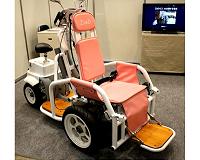
Futuristic predictions about what the cars of tomorrow will look like vary widely. Some Japanese entrepreneurs are sure of a few key features, however: low weight and high utility.
Such is the thinking at ZieD (pronounced "zee-ed"), a small Yokohama-based motorized transport designer. The company is touting its latest two-seat vehicle, dubbed the ZieD-C1, as a solution for Japan's aging society, in which people will become increasingly immobile.
"A hundred years ago, many predicted a world where everyone would have their own personal automobile. "Going forward, the question is: 'how compact and how useful can it be?' says ZieD CEO Takashi Sawada. "Big automakers have traditionally dominated the space for vehicles that weigh up to 2,000 pounds, but natural resource limits dictate a different future."
The four-wheeled, two-seat ZieD-C1 looks like a hybrid wheelchair with the driver in the rear. It measures about two meters in length, sports a top speed of 19km/h and a range of about 40km. Overall weight comes to about 118kg (260 lbs.), thanks to its 0.6kW electric motor.
"The machine is designed for Japan's future, in which people will need reliable, short-range transportation to fill basic needs like grocery shopping and bill paying," says Mr. Sawada, himself an ex-Sony engineer who heads a staff of six at his firm.
Japan's unfolding population crisis has been well documented. While advances in health science, diet, and social services since the end of WWII have sent Japan's average life expectancy to a world-leading 84 years, a steadily falling birth rate has meant that 33% of the citizenry was at least 60 years of age by 2014.
Barring massive interventionist measures, projections hold that the total population will fall by one-third to just 87 million by 2060.
The changing distribution of that population is also a concern. Greater Tokyo is virtually the only area in in the country experiencing growth, but that is mostly due to internal migration from other parts of the country.
"Increasingly, the country's elderly live in rural areas, where ready access to transportation is limited for people who aren't already reasonably able-bodied, and where the terrain is hilly to mountainous," adds Mr. Sawada.
The problem may be even more serious when considering that Japan's economy is not geared to handle such internal demand. In 2014, the nation exported over 77 million vehicles of all types (including passenger cars, trucks and buses) against just 5.5 million domestic new vehicle registrations. Toyota, Honda and Nissan remain the largest carmakers in the country.
As such, the scale of Japan Inc.'s operations do not allow for niche market projects, contends Mr. Sawada. "The situation leaves an opportunity for smaller companies and entrepreneurs. We need be able to come up with creative designs and ideas that will eventually allow for the mass production of vehicles such as ours in numbers that affordably address the problem. Right now it's simply too expensive to make them one at a time."
Japan's experience with electric vehicles may offer hope, however. After years of government subsidy programs, the country's 150,000-strong fleet of light-duty plug-in electric vehicles is currently the third largest in the world after the United States and China.
