
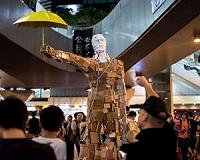
China on Thursday accused the United States of seeking to "destroy" Hong Kong and threatened retaliation after Congress passed new legislation supporting the pro-democracy movement that has thrown the city into nearly six months of turmoil.
Foreign Minister Wang Yi said the passage of the Hong Kong Human Rights and Democracy Act "indulges violent criminals" that China blames for the worsening unrest and aims to "muddle or even destroy Hong Kong".
The legislation — which now awaits President Donald Trump's signature into law — backs universal suffrage, freedom from arbitrary arrest, and sanctions against those who contravene such principles.
It was passed by the House of Representatives on Wednesday despite warnings from China, which angrily rejects criticism of its handling of Hong Kong.
Hong Kong's months of protest began with a now-shelved bill to allow extraditions to mainland China, which revived fears that Beijing was slicing into the city's freedoms.
Millions of angry citizens have taken to the streets in giant marches, and protesters have repeatedly clashed with police in a movement that has widened to include calls for democracy and an inquiry into alleged police brutality.
Hong Kong's Beijing-appointed leaders have rebuffed the demands.
The resistance has focused in recent days on the campus of the Hong Kong Polytechnic University, with fiery clashes that saw police firing tear gas and rubber bullets at protesters, who shot arrows and lobbed Molotov cocktails.
– Bring it on –
The university remained under siege Thursday, with dozens of holdouts in the movement's signature black colours defying official calls to surrender.
Hundreds have fled the campus out of fear or deteriorating living conditions this week, most of them quickly arrested by police on rioting allegations.
Exhausted protesters draped in gold and silver medical blankets continued to trickle out of Thursday.
But a 30-year-old masked protester who gave his name as "Mike" scoffed at surrendering, saying international and local pressure would cause authorities to make a humiliating "retreat".
"Please try! You're welcome (to storm the campus)," he told AFP, in a message to police.
"It will be a fun game of hide-and-seek."
"Police are making the wrong calculation here if they think we will surrender. We have plenty of resources, plenty of food and water. We can last a month."
In some areas, materials used for making Molotov cocktails were strewn about — accompanied by warnings against smoking — and graffiti was seen throughout the campus, including messages such as "You can kill a man, you can't kill an idea."
– 'Naked interference' –
The turmoil has already tipped Hong Kong's economy into recession and the threat of a change in trade status brought fresh gloom.
Hong Kong's benchmark stock index ended sharply lower, and other Asian markets also lost ground over fears that the rights legislation could derail the delicate effort to settle the trade war between the world's two biggest economies.
Wang, Beijing's top diplomat, condemned the bill as "naked interference in China's internal affairs", according to the foreign ministry, which said the comments were made during a meeting in Beijing with former US defense secretary William Cohen.
A foreign ministry spokesman also vowed that China would "take effective measures to resolutely fight back", giving no details.
Hong Kong is a semi-autonomous Chinese region and US policy treats its economy as separate from the rest of China.
That has been a key factor in the city's rise as an international financial hub, and left it exempt from the crippling tariffs imposed by Trump's administration.
The new US bill would require an annual review of that status, which could be revoked if the city's unique freedoms are quashed.
Beijing has repeatedly said it may act if Hong Kong spirals out of control, and China's state media said the US legislation would not change that calculus.
"Some may expect this to deter Beijing," the government mouthpiece Global Times said. "Such thinking is naive."
China releases video of UK consulate worker's confession
Beijing (AFP) Nov 21, 2019 –
Chinese police published Thursday a video purporting to show a former employee of the British consulate in Hong Kong confessing to soliciting prostitutes, after Britain backed his allegation that he was tortured over pro-democracy protests.
The case has added to tensions between Beijing and London over the demonstrations that have roiled the former British colony for months.
Simon Cheng, a Hong Kong citizen, said on Wednesday he was shackled to a steel "tiger chair", hung spread-eagled on a "steep X-Cross" and beaten by secret police while he was detained in the southern mainland city of Shenzhen for 15 days in August.
Cheng said in a statement on Facebook that police had accused him of being a British spy and questioned him about London's role in protests that have wracked the semi-autonomous city for months.
Cheng said he felt he had no choice but to make a filmed confession to "soliciting prostitution", a charge that he said was offered by police as an alternative to "indefinite criminal detention", and that he had not been allowed to contact his family.
He added in the statement that he had "got a massage for relaxation after work hours".
Shenzhen police on Thursday posted a video on the Twitter-like Weibo platform purporting to show Cheng entering and leaving a room in a "clubhouse" multiple times.
AFP could not immediately verify the video, which also contained separate footage in which Cheng is asked why he does not want police to tell his family about his detention.
Cheng says this is because it is a "shameful incident", adding that he feels "too ashamed to meet my girlfriend and my family".
"I am determined to mend my ways and I will never make the same mistake again," he says.
He is not heard speaking about prostitutes.
– 'Amounts to torture' –
The video, initially published on Weibo and Twitter by the state-run People's Daily, was accompanied by a description that said Cheng had confessed to hiring sex workers three times in half a month.
Chinese criminal suspects often appear in videotaped "confessions" that rights groups say sometimes bear the hallmarks of official arm-twisting.
Chinese foreign ministry spokesman Geng Shuang on Wednesday said that Shenzhen police had "guaranteed" Cheng's "legitimate rights and interests in accordance with the law".
Cheng was placed in administrative detention after visiting the southern Chinese city of Shenzhen in August.
He said in his statement that police hand given him a "script" with questions and answers "totally designed by them in advance" for a filmed confession.
British Foreign Secretary Dominic Raab said Wednesday that Cheng's allegations are credible and that the treatment "amounts to torture".
Raab told BBC radio that he summoned the Chinese ambassador to denounce the "disgraceful" and "outrageous behaviour from the authorities in China" which violate international law.
Amnesty International also said Cheng's testimony was credible because his allegations were "in line with the endemic torture and other ill-treatment in detention we have repeatedly documented in mainland China".
Cheng, who has said he was asked to resign from the consulate, could not be immediately reached for comment about the video. In his Facebook post, he said he would not be making further statements.
