
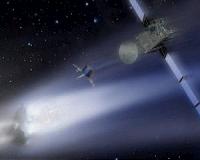
For millennia, the sight of a comet filled humans with awe or dread.
The birth of Jesus, the assassination of Julius Caesar, the Great Plague of London, the coming of war or peace, bountiful harvests or famine… all thought to be portended by cosmic herald.
Bit by bit, mysticism about comets has been replaced by fact as scientists discover more about these epic and ancient travellers of the skies.
As it turns out, comets may be more extraordinary than even the deepest superstition could imagine.
They may even have brought life to our planet, according to some theories.
For decades, astrophysicists have debated whether, at the dawn of our Solar System, comets peppered Earth with some of the chemical essentials for life as we know it.
The Rosetta mission hopes to provide an answer.
It comprises a three-tonne orbiter which on Wednesday sent down a 100-kilogramme (220-pound) robot lab, Philae, to Comet 67P/Churyumov-Gerasimenko.
"Comets are the most ancient objects in the Solar System," Francis Rocard of France's National Centre for Space Studies (CNES), told AFP.
"We want to know if comets played a part in providing Earth with water and carbon. There is no doubt that the results from Rosetta and Philae will shake up what we know."
Dubbed "dirty snowballs" by US astronomer Fred Whipple, comets are deemed to be clusters of primeval carbon and ice, typically a few kilometres (miles) across.
Blacker than coal, they were formed shortly after the Sun flared into life in a halo of dust and gas — the stuff that eventually formed the planets and other bodies.
Today, the Solar System is considered a pretty quiet place compared to 4.6 billion years ago, when it was a shooting gallery.
The nascent Earth would have been whacked over and over again by comets and asteroids, swelling the planet in size and depositing ice, which on some theories became today's oceans.
"This would have created a wonderful culture medium — a liquid enabling highly rich carbon material to react and create prebiotic chemistry," said Rocard.
"It would have led to the first membranes and ultimately the first cells — life itself," he said.
The key to confirming this theory lies in the ratio of hydrogen and deuterium on the comet, which will be compared to the chemical make-up of water on Earth.
Doomed to orbit the Sun in elliptical circuits, comets undergo thermal and gravity stress as they near the star.
Some of their ice is melted and transformed into gusts of gas, the bright "coma" around a comet's head.
– Hairy star –
The gassy wake, and dust loosened by the melting ice, creates a spectacular tail reflected in the Sun's rays and may stretch across millions of kilometres.
The word for comet comes from "stella cometa" — Latin for "long-haired star".
The best-known is Halley's Comet, named after 17th-century English astronomer Edmond Halley, who was the first to show that comets orbit the Sun and return regularly.
Just over 5,000 comets have been observed since the first recorded sighting by Chinese skygazers around 240 BC.
But some experts believe there could be as many as a trillion out there, the European Space Agency says.
"Short period" comets take less than 200 years to complete an orbit. They are believed to return to the Kuiper Belt, just beyond the orbit of Neptune.
"Long period" comets return to the Oort Cloud, a vast, frigid, dark place on the Solar System's fringes.
Some of these last swung by more than 100,000 years ago, when Homo sapiens ventured out of Africa, at the start of our conquest of the planet.
Mission Rosetta: Behind the names
Paris (AFP) Nov 12, 2014 –
What those names mean in Europe's comet-chasing Rosetta mission:
– ROSETTA: Named after the Rosetta Stone, now housed in the British Museum, which helped unravel one of the greatest puzzles of the early 19th century. Bearing a carved text in hieroglyphs and Greek, the stone was found by French soldiers in 1799 near the village of Rashid (Rosetta) in the Nile delta. An English physicist, Thomas Young, and a French scholar, Jean-Francois Champollion, were able to figure out most of the hieroglyphs thanks to the Greek equivalent. The mysterious culture of the Pharaohs was at last explained.
– PHILAE: A 15-year-old Italian girl, Serena Olga Vismara, proposed Philae in a competition to name Rosetta's scientific payload, a 100-kilogramme (220-pound) lander. The name comes from an obelisk found on the island of Philae on the Nile. Now standing in a garden of a country house in the southern English county of Dorset, the obelisk has a bilingual inscription bearing the names of Cleopatra and Ptolemy. It gave Champollion the clinching clue to the hieroglyphs on the Rosetta Stone.
– AGILKIA: The designated landing site for Philae. Named after an island on the Nile which became the new home of Pharaonic temples transferred from Philae when the Aswan Dam threatened to flood the complex.
– 67P/CHURYUMOV-GERASIMENKO: Named after two Soviet-era Ukrainian astronomers credited with discovering it in 1969 — Klim Churyumov of the University of Kiev and Svetlana Gerasimenko of the Institute of Astrophysics in Dushanbe, Tajikistan. "P" refers to a periodic comet, or a comet whose revolution around the Sun is less than 200 years, while "67" refers to its number on a list.
