
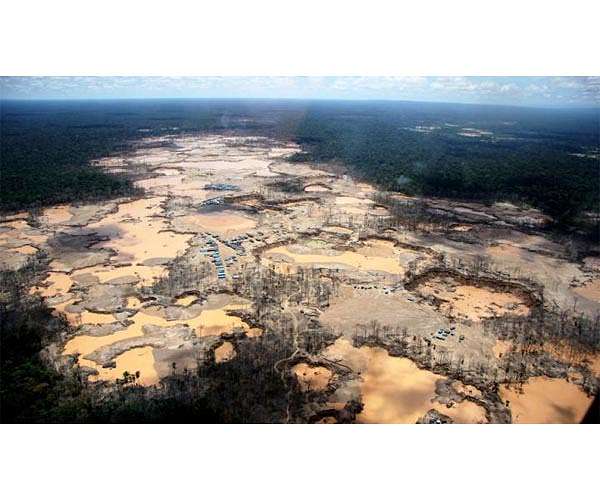
Deep in the jungle in France's overseas territory of French Guiana, the army is engaged in a battle of attrition with illegal gold miners who have destroyed thousands of hectares of precious Amazon rainforest.
French Guiana, about the size of Portugal on the north shore of South America and almost completely covered in forest, has a long history of small-scale gold mining, legal and illegal.
But high gold prices have accelerated the scramble for the precious metal, with thousands of miners from neighbouring Brazil pouring across the border to try to cash in.
Their activity has left treeless brown gashes in the landscape, dotted with pools of water poisoned with the mercury used to extract gold from the soil.
Catching the illegal miners known as "garimpeiros" in the act is a nearly impossible task, but France is determined to try to protect its little corner of the Amazon.
– Burying the evidence –
On a small tributary of the Maroni river, the main waterway running north through Guiana to the Atlantic Ocean, French troops carry out a raid on an illegal mining site.
But by the time they arrive by canoe, guns at the ready, the miners have melted away into the forest after receiving a tip-off from lookouts.
The troops manage to apprehend two undocumented workers at the site but they were not caught in the act, so are freed.
Five soldiers in fatigues then scramble down a bank into the water-filled mining pit to search for hidden equipment.
Taking care not to splash their faces with the toxic liquid they fish out an engine and two mechanical pumps, which they destroy.
In a sign that the site could be reactivated soon after the troops leave, two men and two women wearing rubber boots linger nearby in the forest.
"If we destroy their material and they still come back it shows that this is an important site for them," said Staff Sergeant Olivier, whose full name was withheld for security reasons.
A child's shoe and a doll discarded on the ground suggested that this little community of outlaws includes children.
But in some places the garimpeiros, who use the gold to buy equipment from Chinese traders on the other side of the Maroni river in Suriname, are accused of bringing prostitution and violence into the forest.
"I've seen a four-poster bed, a mosquito net and condoms strewn everywhere" at one abandoned site, said Laura, a military police officer.
– Rivers poisoned –
Authorities in French Guiana estimate that 400 hectares of forest are destroyed each year by illegal mining, which threatens biodiversity in this relatively untouched part of the Amazon basin.
Arnaud Ancelin, deputy director of the Guiana Amazonian Park, a protected area covering 34,000 square kilometres (13,000 square miles) of rainforest, said the run-off from some mining sites created mercury-laced mud torrents "that block the gills of fish" and threaten the survival of their predators, including the otter.
The use of mercury, which has been banned in French Guiana since 2006, also poses major health risks for indigenous Amerindians, who have a fish-rich diet.
With 8,000 to 9,000 illegal miners believed to be operating at around 150 sites across the territory — up from 110 a decade ago — the nearly 1,000 French troops deployed to combat the prospectors are struggling to keep up.
– Tonnes of gold –
The garimpeiros are the smallest links in a chain, where those with their hands in the mud are paid a pittance while those in charge of transporting the gold race up and down the river in motorboats.
"We're only catching the little guys," French Guiana's public prosecutor Samuel Finielz told AFP.
Since January, the authorities have seized three kilogrammes of gold, a fraction of the roughly 10 tonnes believed to be illegally extracted each year.
But Finielz is adamant that the efforts are helping to prevent French Guiana's corner of the Amazon suffer the same fate as that of Brazil, which has endured massive deforestation.
"We're managing to contain illegal mining and in some instances reduce it," he said. "But we're not managing to put an end to it."
Brazil Amazon deforestation up 22% in a year, 15-yr record
Brasilia (AFP) Nov 19, 2021 –
Deforestation in Brazil's Amazon rainforest rose by almost 22 percent in one year, the highest level in 15 years, according to figures Thursday that cast doubt on promises by President Jair Bolsonaro's government to reverse the trend with "forceful" action.
The 13,235 square kilometers (5,110 square miles) of forest lost from August 2020 to July 2021 period was the largest swath since 14,286 km2 were cleared in 2005-06, according to an estimate by Brazil's national space research institute INPE.
It is the third time in a row that annual Amazon deforestation has increased under Bolsonaro, whom the opposition blames for the spike due to his encouraging of farming and mining activity.
Environment Minister Joaquim Leite admitted the figures represent "a challenge" and vowed to be "more forceful against environmental crimes."
He also insisted the data "does not exactly reflect the situation in the last few months."
However, last week INPE said it had registered the worst October on record for deforestation, with an area more than half the size of the city of Rio de Janeiro cleared.
The government says it has intensified its attempts to combat illegal deforestation by deploying more troops on the ground.
"To those who still insist on these environmental crimes, [we warn] that the Brazilian state will enter the Amazon with full force," said the Minister of Justice and Public Security Anderson Torres.
Brazil was among the signatories to an international pledge made at the COP26 summit in Glasgow to end deforestation by 2030.
Bolsonaro went even further by pledging to eliminate illegal deforestation in the giant South American country — home to 60 percent of the Amazon — by 2028, pulling forward a previous target by two years.
The far-right president came to power in January 2019 with a strong anti-environmentalist message and has been accused by NGOs, indigenous groups and the political opposition of weakening environmental safeguards.
Between August 2018 and July 2019, 10,129 km2 of the Amazon were cleared, a spike of 34 percent over the same period in the previous year, according to INPE.
In the following period, from 2019-2020, 10,851 km2 were lost, an increase of seven percent, despite the deployment of costly military operations to the jungle to confront illegal loggers, miners and ranchers during the most intense periods of Amazon deforestation and fires.
Marcio Astrini, head of the Climate Observatory that brings together environmental groups operating in Brazil, said the latest figures were "the result of a persistent, planned and continuous effort to destroy environmental protection policies" under the Bolsonaro administration.
The Observatory accused the government of hiding the data until after COP26, noting that the document released by INPE — which is affiliated to the Ministry of Science, Technology and Innovations — was dated October 27, 2021.
"The government already had deforestation data in its hands when the Scotland climate conference was taking place and deliberately omitted it," the NGO said in a statement.
The government denied any cover-up. "The information I have is that this was disclosed today," Minister Leite replied.
