
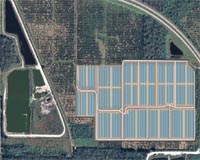
Florida Power and Light Company has received approval from the Florida Public Service Commission (PSC) to begin construction of three solar energy centers that will make Florida the second largest supplier of utility-generated solar power in the nation.
"The decision by the PSC represents a major step forward in making Florida a leader in solar power generation. At a time of record-setting fossil fuel prices and concern over global climate change, solar power helps to meet the goals of protecting the environment and enhancing Florida's energy security. Governor Crist and the state legislature set a goal of increasing renewable energy in Florida, and as a clean energy company we are committed to playing a meaningful role in this endeavor," said FPL President Armando J. Olivera.
Earlier this year, the Florida Legislature approved and the Governor signed into law a comprehensive energy bill which provided for the development of renewable energy, subject to PSC approval. FPL, a subsidiary of clean energy leader FPL Group, presented a proposal to the PSC for three solar energy centers that includes the world's largest photovoltaic solar array and the first "hybrid" energy center that will couple solar thermal technology with an existing natural gas combined-cycle generation unit.
The projects are:
The DeSoto Next Generation Solar Energy Center Planned for construction on FPL-owned property in DeSoto County, Fla., the DeSoto project will provide 25 megawatts of photovoltaic solar capacity, making it the world's largest photovoltaic solar facility. DeSoto is expected to be in service by December 2009.
The Martin Next Generation Solar Energy Center Planned for construction at FPL's existing Martin Plant site, the Martin project will provide up to 75 megawatts of solar thermal capacity in an innovative "hybrid" design that will connect to an existing combined-cycle power plant. It is the world's first project to integrate solar thermal steam generation into a combined-cycle steam turbine. When the power of the sun is being harnessed to produce electricity from steam, less natural gas is required. The Martin facility is expected to be on-line at the end of 2009 and completed by 2010.
The Space Coast Next Generation Solar Energy Center Planned for construction at the Kennedy Space Center, the Space Coast project will provide 10 megawatts of photovoltaic solar capacity in an innovative public-private partnership. Space Coast Solar will be operating by the first quarter of 2010.
Environmental Benefits
The Florida solar facilities will prevent the release of nearly 3.5 million tons of greenhouses gases over the life of the projects, which is the equivalent of removing 25,000 cars from the road per year, according to the U.S. Environmental Protection Agency.
In addition, photovoltaic solar systems, which convert sunlight directly to electricity, consume no fuel, use no water, and produce no waste. FPL's unique solar thermal design, which uses the power of the sun to produce electricity from steam, uses no fossil fuel, no additional cooling water and produces zero greenhouse gas emissions.
"Our Florida projects will benefit FPL's customers by increasing the amount of clean, renewable energy while decreasing greenhouse emissions and displacing the use of oil and natural gas," Olivera said.
Fulfilling a Commitment
FPL's three solar projects represent an accelerated implementation schedule of the commitments the company made at the Clinton Global Initiative in September 2007, which called for an initial 10 megawatt trial followed by the construction of 300 megawatts of solar power in Florida and 500 megawatts nationwide over seven years. With the approval of 110 megawatts of solar power, FPL is well on its way to meeting more than one third of its Florida target in less than a year.
Clean Energy Leadership
The Florida solar projects will help extend FPL Group's lead as the world's No. 1 producer of solar energy. FPL Energy is the nation's No. 1 producer of wind power with 5,410 megawatts of installed capacity at 56 sites in 16 states.
Overall, FPL Group's generation fleet, with a capacity of 38,105 megawatts, has one of the lowest carbon dioxide emission rates in the country. FPL is the nation's No. 1 utility for energy conservation, according to U.S. Department of Energy data. FPL's conservation programs have helped the company avoid the need to build 12 medium-sized power plants since 1980, more than any other utility.
