
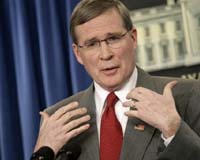
The United States downplayed Wednesday differences with partners on proposed UN sanctions on Iran for its nuclear program as "sausage making," and assured an agreement would be made. President George W. Bush's national security advisor Stephen Hadley made the remark as he stressed the need for a United Nations resolution on sanctions ahead of exploratory talks on Iran between Washington and five other major powers.
Hadley, travelling with the president aboard Air Force One for the APEC summit in Asia, said Iran must face "consequences" for refusing a UN demand to suspend sensitive nuclear fuel work.
Speaking to reporters after a brief stopover in Moscow en route to Singapore, Hadley said the United States and the other four UN Security Council members — Britain, France, China and Russia — plus Germany were discussing what should be in the proposed resolution, and what should be saved for a further resolution if needed.
"These are largely tactical considerations but the strategy, I think, there is agreement on," he said.
Hadley described as "troubling" the latest report by the International Atomic Energy Agency, the UN nuclear watchdog agency, of their discovery in Iran of traces of plutonium, a possible weapons material.
The find leads to suspicions that, contrary to what Iran was saying, "something more nefarious" is going on, he said.
Hadley said Bush had met with Russian President Vladimir Putin during the Moscow stopover and the leaders briefly had discussed the Iranian and North Korean nuclear crises.
Hadley said he had met with his Russian counterpart, Igor Ivanov, the head of Russia's security council, and talked about the difficulties in finding an agreement on a UN resolution punishing Iran.
With exploratory talks still underway after three weeks of efforts, Hadley highlighted the complications of the diplomatic process.
"It's a little bit like sausage making, it's not pretty, and a lot of it spills out into the public," he said. "But I think the international community has held together on this issue and I think we will again."
On Tuesday, the State Department said Undersecretary of State Nicholas Burns had spoken with his five counterparts in a bid to break the stalemate, but there were no signs of an imminent breakthrough.
The previous informal meeting of envoys from Germany and the UN Security Council's permanent members, on Monday, reviewed a European draft resolution urging nuclear and ballistic missile-related sanctions against Iran.
The draft put forward by Britain, France and Germany includes travel bans and financial restrictions on Iranian scientists working on the nuclear and missile programs.
However Russia and China, which both maintain close energy and trade ties with Tehran, saw it as too tough and in the end counter-productive.
Source: Agence France-Presse
