
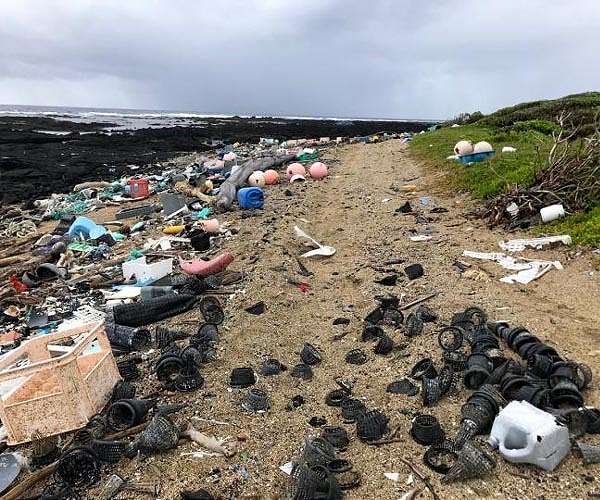
Island nations like the Seychelles are uniquely vulnerable to the barrage of plastic pollution pouring into the world's oceans, and research published Thursday in the journal Scientific Reports suggests the cleanup bill is prohibitively expensive.
"The Indian Ocean is fringed with countries that have poor waste management infrastructure," lead researcher April Burt told UPI in an email.
"Other studies have shown that most of the marine plastic litter in the oceans is coming from ten rivers, the majority of which are in Asia," said Burt, an ecologist and graduate student at Oxford University in Britain.
Cleanup efforts on the Seychelles revealed an abundance of plastic shoes, mostly flip flops, as well as netting and line from commercial fishing operations.
To estimate the financial burden the barrage of plastic places on small island nations like the Seychelles, Burt and her research partners first calculated the effort to clean a small portion of the coast.
Scientists determined a 2019 cleanup, comprising 980 hours of work by 12 volunteers over the course of five weeks, cost a total of $224,538.
Next, researchers set out to estimate the total amount of plastic found strewn across Aldabra, the Seychelles' outer islands and the world's second-largest coral atoll.
"We conducted a series of transects at 20 locations along the coast in each of the main coastal habitat types: beach, vegetation and limestone karst," Burt said. "For each transect we separated and weighed the litter found into six main categories and used this to extrapolate up to estimate total litter accumulated."
The six litter categories included: consumer plastic items, such as toothbrushes and cigarette lighters; plastic packaging material like plastic bottles; fishing-related items, such as buoys and netting; plastic footwear; small, unidentified plastic fragments; and other materials like glass.
"Our research shows that the main source was from the industrial tuna fisheries — this industry exports tuna worldwide," Burt said.
When researchers added it all up, they determined it would require 18,000 hours of labor and cost $4.68 million to clean up all the plastic pollution found along the Aldabra coast.
Because much of the plastic pollution that makes its way to the shores of smaller island nations is coming from bigger, richer nations and extractive industries, the researchers suggest that wealthier countries help pay for the cleanup.
"We hope our findings will be used by local and regional governments to call out the need for international funding for dealing with the issue of marine plastic litter," Burt said.
Burt also said more must be done to ensure the commercial fishing industry can't continue to dump waste with impunity.
"The huge costs involved in removal are way beyond the financial capacity of local organizations and governments who are responsible for these island ecosystems," she said.
Navy expands CBD ban to include lotions, shampoos
Washington DC (UPI) Sep 10, 2020 –
The Navy has expanded its ban on hemp and cannabidiol, or CBD, products that contain to include lotions and shampoos.
The expanded ban, announced this week on social media and internally in July, is intended to "protect Sailors from potential tetrahydrocannabinol, or THC, exposure," since it's impossible to tell whether — and how much — residual THC a product might contain.
Federal law allows consumers to use products that contain less than 0.3 percent THC, but the Navy policy is meant to ensure sailors don't consume THC unknowingly, therefore creating false positives on a drug test.
"This really is about the health of the force and ensuring the Navy remains a drug-free workplace," said LA Parker, Drug Detection & Deterrence branch head, for the 21st Century Sailor office. "We have to be fit to fight and can't take a risk in allowing our Sailors to consume or use these types of products."
The Navy does allow for use of CBD formulations if a service member has a valid prescription, and in the press statement encouraged sailors to consult with their primary care physician to make sure the prescription is documented in their medical record.
The branch also still allows the use of durable hemp goods, like rope or clothing.
The policy update was released to service members just days after the House of Representatives approved an amendment to the National Defense Authorization Act that would allow all military service members to use hemp and CBD products.
But the Senate did not include a similar provision in its version of the annual National Defense Authorization Act
And on Wednesday, Rep. Mac Thornberry, R-Texas, said Congress is unlikely to vote on the NDAA until after the Nov. 3 election.
