
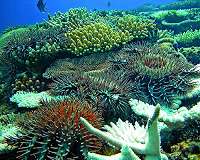
The slime-covered lips of the tubelip wrasse, a fish common among the coral reefs of the Indian and western Pacific oceans, allow the species to eat razor-ship, venomous coral.
The vast majority of fish species utilize coral exclusively for shelter. Of the 6,000 fish species that call coral reefs home, only 128 species have been observed feeding on corals.
Corals boast razor sharp skeletons and venomous, mucus-covered stinging cells, making them quite difficult to safely consume. To find out how exactly the tubelip wrasse eat coral without suffering the consequences, researchers honed the lens of a scanning electron microscope on the species' mouth during feeding.
The high-def images showed the species unique tube-like lips form a protective barrier while the fish uses a suction-like feeding technique to consume coral flesh.
The species' lips feature an array of folds that are filled with mucus-secretion glands.
"The lips are like the gills of a mushroom but covered in slime," David Bellwood, a researcher at James Cook University in Australia, said in a news release. "It is like having a running nose but having running lips instead."
High-speed video showed the species' lips completely cover the fish's teeth while suctioning onto the coral, forming a tube-like vacuum through which the wrasse slurps up coral flesh and mucus.
"One always assumes that fishes feed using their teeth, but, like us, the lips can be an essential tool," Bellwood says. "Imagine feeding without lips or cheeks; the same applies to fishes."
Researchers detailed their investigation of the tubelip wrasse's slime-covered lips in the journal Current Biology.
First UN talks to save oceans kick off Monday
World leaders convene at UN headquarters next week for the first major bid to solve the toughest problems facing our oceans, from coral bleaching to plastic pollution, overfishing and rising seas due to climate change.
The Ocean Conference in New York June 5-9 attempts to rally nations big and small to make meaningful changes to preserve what is arguably the Earth's most important resource, … read more
