
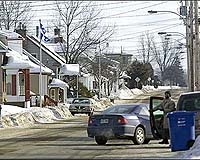
This season's worst snowstorm blanketed southern Ontario Wednesday, forcing several flight cancellations and school closures, and tormenting drivers as it swept eastward. In Toronto, Montreal and Ottawa, dozens of flights, mostly to large American cities, were cancelled, according to airport authorities. Several cars slipped off icy roads in Ontario and Quebec provinces, where visibility was poor, as strong winds kicked up swirls of snow, transport officials said.
"It's the first big storm of the year. It's not commonplace, but at the same time, it's not the end of the world," Denis Heroux, an Environment Canada meteorologist at Montreal airport, told AFP.
Almost 25 centimeters (10 inches) of snow was expected to fall in Montreal Wednesday, and up to 40 centimeters (16 inches) was likely in southern Quebec, along the Canada-US border.
"It's almost as much snow in one day as has fallen since the beginning of winter," said Heroux, noting that Montreal received only 70 centimeters (27.5 inches) of snow this year, half the normal snowfall.
The storm started in the American Midwest and moved into the northeastern United States Tuesday where it wreaked havoc as it dumped snow, sleet and rain.
In southern Ontario, Canada's economic hub, the storm dropped a thick blanket of snow on roads, causing school closures and traffic delays.
Up to 70 centimeters (27.5 inches) of snow was expected to fall on Hamilton, near Toronto, Tuesday and Wednesday, Environment Canada said.
The government weather agency also issued a storm warning for cities bordering Lake Erie, and a wind chill warning for Kingston, Ontario on Tuesday night, when temperatures felt like minus 30 degrees Celsius (minus 22 degrees Fahrenheit) because of winds gusting to 50 kilometers per hour (31 miles per hour).
On the American side, some 65 centimeters (25.5 inches) of snow was expected to fall in Vermont, according to US meteorological services.
The massive low pressure center behind the storm that climbed up the eastern American seaboard was expected to hit Cape Cod, Massachusetts Wednesday night, and Canada's Maritime provinces the following night.
Source: Agence France-Presse
