
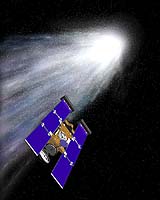
Microscopic grains recovered from a comet by a US spaceprobe in an epic voyage could revise mainstream notions about how these lonely wanderers of the Solar System are born, scientists report on Thursday. "Many people imagined that comets formed in total isolation from the rest of the Solar System," said Donald Brownlee, lead scientist in the Stardust expedition, which returned to Earth specks trailed by Comet Wild 2.
"We have shown that's not true."
One of the most innovative experiments in space history, Stardust captured the dust in a mattress of neutral gel as it zipped through the comet's tail, beyond the orbit of Mars, in January 2004.
In January this year, the probe delivered a capsule containing the precious grains, which drifted safely to Earth in Utah by parachute.
Since then, the researchers have spent their time gently retrieving the dust from the gel and analysing their composition.
Their first report, published on Friday in the US journal Science, throws up a surprise.
They found calcium-aluminium inclusions, a rare crystalline material forged in the extreme heat of the inner Solar System.
Comets are agglomerations of ice and dust that are usually characterised as primeval rubble left from the building of our planetary system.
They are believed to have formed on the fringes of the Solar System but have been captured by the Sun, doomed to orbit the star until their bodies are eventually whittled to nothing.
Layers of ice melt as the comet nears the Sun, thus depositing the dust, which shows up in the sunlight as the comet's famous "tail."
Brownlee says as much as 10 percent of Wild 2's dust may have been forged at distances close to the Sun.
"That's a real surprise, because the common expectation was that comets would be made of interstellar dust and ice," the University of Washington astronomer said in a press release.
How did this Sun-sizzled dust end up beyond Pluto, some 4,600 million years ago?
One idea is that the early Solar System was a turbulent place, a brew of gases and dust stirred, possibly violently, by solar convection and gravity.
"I think of the Solar System partially turning itself inside out," said Brownlee.
One question, though, is whether Wild 2 can be considered a cometary benchmark. It appears to have been somewhat different from Tempel 1, a space rock that was whacked last year by NASA's "Deep Impact" probe to analyse what came out.
Tempel 1 was examined remotely from a distance, using optical and infra-red sensors, whereas Stardust returned actual samples.
"The comets may be different from each other, or different observations could simply be a result of the different techniques used to examine them. It is a challenge for us to understand how they are different, and why," said Brownlee.
Source: Agence France-Presse
