
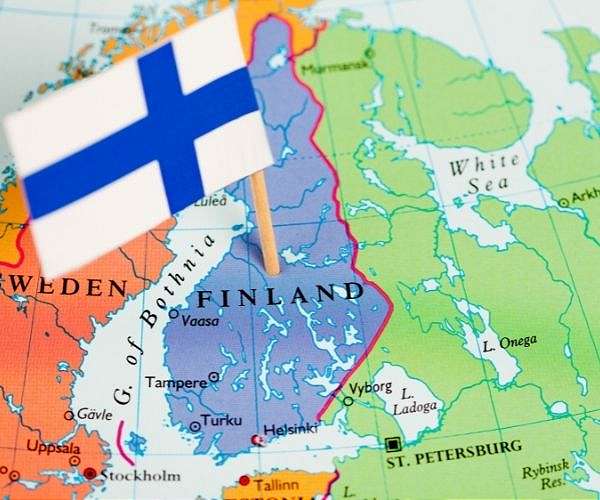
Finland announced Tuesday it would increase its military spending by more than two billion euros over the next four years, saying the decision was spurred on by Russia's invasion of Ukraine.
The decision to increase the defence budget follows unusually short budget negotiations in the Nordic country that shares Europe's longest land border with Russia.
"The war in Europe has fundamentally changed our security environment," Defence Minister Antti Kaikkonen said in a statement.
"For this reason we have decided to allocate a significant budgetary increase to the defence forces," he added.
The additional funds, totalling 2.2 billion euros ($2.4 billion), would be spread out over four years, with 788 million euros added in 2023 and then 408 million euros a year until 2026.
With Russia's invasion of Ukraine, security has become a more urgent issue in Finland and reignited a debate about potential NATO membership in the country.
Traditionally most Finns have opposed joining the military alliance but recent polls have for the first time showed a majority in favour of membership.
Finland's President Sauli Niinisto has urged Finns to keep a cool head on the issue and called for the country to decide "without hesitation but carefully" on the issue.
Since the assault on Ukraine, Finnish leaders have held multiple meetings with their US and Nordic counterparts regarding Finnish defence and security.
NATO allies move to rearm Kyiv; fears of more atrocities'
Brussels (AFP) April 5, 2022 –
NATO's chief Jens Stoltenberg said Tuesday he feared "more atrocities" in Ukraine, as allies moved to rearm the country ahead of an expected Russian offensive in its east.
Speaking a day before NATO foreign ministers gather to discuss additional support to Kyiv, Stoltenberg said the alliance supported investigations into "the horrific images of murdered civilians in Bucha and other places" in Ukraine from which Russian forces had pulled back.
"When and if they withdraw the troops and Ukrainian troops take over, I'm afraid they will see more mass graves, more atrocities and more examples of war crimes," he told a media conference.
The Russian pull-back from areas around heavily defended Kyiv is seen by NATO countries as a redeployment to allow Moscow to focus instead on Ukraine's east and south.
Moscow has maintained Russian-speaking footholds in eastern Ukraine since 2014, when it annexed the Crimean peninsula and backed separatists in the eastern Donbas region bordering Russia.
"Moscow is not giving up its ambitions in Ukraine. We now see a significant movement of troops away from Kyiv, to regroup, rearm and resupply. And they shift their focus to the east," Stoltenberg said.
"In the coming weeks, we expect a further Russian push in the eastern and southern Ukraine to try to take the entire Donbas and to create a land bridge to occupied Crimea," he said.
"This is a crucial phase of the war," he said.
Stoltenberg said NATO foreign ministers meeting on Wednesday and Thursday were expected to discuss their countries providing "more advanced equipment and military support" to help Kyiv's forces withstand the predicted assault.
The weapons would include "Javelins and other anti-tank weapons which have proven extremely effective on the battlefield," he said.
Stoltenberg added that "the more strength we can provide to the Ukrainian armed forces, the better results they can achieve at the negotiating table" in peace talks with Russia.
The US ambassador to NATO, Julianne Smith, told journalists that the supply of weapons to Ukraine was not a NATO operation but "sovereign decisions" by countries in the alliance.
"I would say over two thirds of the allies are actually providing lethal assistance in one form or another," she said, declining to detail what arms were being given.
The NATO ministers were to be joined by counterparts from non-NATO partner countries Australia, Finland, Georgia, Japan, New Zealand, South Korea and Sweden.
On the sidelines of the NATO gathering, the foreign ministers of the G7 — comprising Britain, Canada, France, Germany, Italy, Japan and the United States — will also meet.
The G7 has already agreed several waves of sanctions against Russia over its invasion of Ukraine.
