
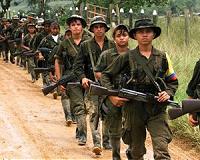
The Revolutionary Armed Forces of Colombia (FARC) on Friday unanimously backed a historic peace deal with the government to end the 52-year conflict there, their chief peace negotiator said.
"The war is over," said Ivan Marquez at a national conference of the FARC to vote on the deal and relaunch the group as a political party.
"The guerrillas… have given their unanimous backing to the final accord," he said, on the sixth and last day of what now promises to be the FARC's final meeting as a rebel army.
Marquez, who led the FARC delegation at nearly four years of peace talks in Cuba, added a reference to one of Colombia's most famous sons, the Nobel prize-winning writer Gabriel Garcia Marquez.
"Tell Mauricio Babilonia he can release the yellow butterflies," he said, an allusion to a character in the master of magical realism's "One Hundred Years of Solitude" who is so love-struck that a cloud of yellow butterflies follows him wherever he goes.
President Juan Manuel Santos and FARC leader Rodrigo Londono — better known by his nom de guerre, Timoleon "Timochenko" Jimenez — will now sign the accord Monday in the Caribbean coast city of Cartagena.
Colombians will then vote on it in a referendum on October 2. Recent polls show the "Yes" camp ahead.
The FARC, a Marxist guerrilla group, launched its war on the Colombian government in 1964, in the aftermath of a brutally repressed peasant uprising.
Over the decades, the conflict has drawn in several leftist rebel groups, right-wing paramilitaries and drug gangs, leaving a legacy of death and destruction that left more than 260,000 people killed, 45,000 missing and forced 6.9 million to flee their homes.
– New world of politics –
The FARC is also due to announce details on its new life as a political party as its conference wraps up Friday in El Diamante, a remote site deep in its traditional stronghold in southeastern Colombia.
"We're going to come out into the world of open politics. The main challenge will be achieving a political platform that brings together the diverse segments of Colombian society," FARC commander Carlos Antonio Lozada told AFP.
Timochenko is expected to keep his role as leader of whatever organization emerges to replace the FARC, which today has an estimated 7,500 fighters.
Some 350 commanders and delegates representing the group's rank and file were present at the meeting.
The rebels came to the negotiating table after being weakened by a major army offensive led by then-defense minister Santos, who served in the post from 2006 to 2009 before becoming president.
After an army raid killed the previous FARC leader, Alfonso Cano, in 2011, Timochenko, his successor, wrote to Santos proposing fresh peace talks — the fourth such effort.
The talks opened in Cuba in November 2012.
Working through a six-point agenda one item at a time, delegates concluded a final, 297-page accord on August 24.
The deal covers justice and reparations for victims of the conflict; land reform; the FARC's relaunch as a political party; disarmament; fighting the drug trafficking that has fueled violence in the world's largest cocaine-producing country; and implementing and monitoring the accord.
It grants an amnesty for "political crimes" committed during the conflict. But the amnesty will not cover the worst atrocities, such as massacres, torture and rape.
Those responsible for such crimes will face up to 20 years in prison, with lighter sentences if they confess.
FARC fighters have vowed to now leave their mountain and jungle hideouts and hand in their weapons in a UN-supervised process.
The government's efforts to open peace talks with a smaller guerrilla group, the National Liberation Army (ELN), have not yet borne fruit.
Colombia's FARC rebels to keep leader Timochenko: commander
El Diamante, Colombia (AFP) Sept 22, 2016 –
Colombia's FARC rebels will keep Timoleon "Timochenko" Jimenez as their leader when they relaunch as a political party under a historic peace deal, a commander said Thursday.
"There's no doubt that Timochenko will be confirmed" as head of the organization that replaces the Revolutionary Armed Forces of Colombia (FARC) under the peace process, commander Carlos Antonio Lozada told AFP.
Jimenez, 57, whose real name is Rodrigo Londono, has worked to guide the FARC toward a negotiated end to the conflict since becoming their commander in chief in 2011.
After taking over from Alfonso Cano, who was killed in a military raid, Jimenez wrote a letter to President Juan Manuel Santos proposing fresh peace talks.
Now, after nearly four years of negotiations, he and Santos are set to sign the final accord Monday.
Under the agreement the FARC — a Marxist guerrilla army launched in 1964 — has pledged to disarm and turn itself into a political party.
The rebels are currently holding what leaders hope will be their last conference as a guerrilla army, where they are due to vote on the peace deal.
FARC leaders say they have overwhelming support from their delegates.
Once the deal is signed, Colombians will vote on it in a decisive referendum on October 2.
