
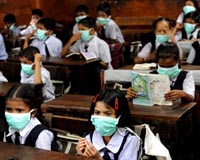
Poor countries face "explosive outbreaks" of the global swine flu pandemic and need speedy financial assistance to access vaccines, UN officials warned on Sunday.
"What we see now is that the A(H1N1) virus is beginning to penetrate into some of the poorest communities in the world," said Julie Hall, an expert from the UN's World Health Organisation.
"We are anticipating that we may well see a different pattern of impact once this virus starts to take off and those explosive outbreaks occur in poorer communities," she told a news conference
David Nabarro, UN senior influenza coordinator, said both manufacturers and rich countries were ready to make vaccines available for developing nations, but warned that the supply would still be inadequate.
"We are aware that there will only be enough for a small percentage of the population of developing countries," he said.
"The challenge during the next few weeks is… to ensure that adequate vaccines reach health workers and essential personnel in developing countries in time to help them as the next waves of the pandemic reach them," he added.
Last week, the WHO said pharmaceutical firms can produce only three billion doses of swine flu vaccines a year, covering less than half of the global population.
Nabarro also called for cash donations to help low-income countries prepare for the pandemic by raising awareness and improving their health services infrastructure.
At least 3,917 people have died from the A(H1N1) virus since it was uncovered in April, with most of the fatalities in the Anericas region, according to the WHO.
related report
World swine flu cases surge, deaths also up: report
The number of swine flu cases worldwide has jumped by at least 24,000 in two weeks to exceed 343,000, while deaths from the A(H1N1) virus edged up to more than 4,100, a US health agency said Monday.
"The World Health Organization (WHO) regions have reported over 343,298 laboratory-confirmed cases of 2009 H1N1 with at least 4,108 deaths, which is an increase of at least 24,373 cases and 191 deaths since September 20," the Centers for Disease Control and Prevention (CDC) said.
The sharp increase in the number of cases was only the tip of the A(H1N1) pandemic iceberg, "as many countries focus surveillance and laboratory testing only on people with severe illness," the CDC said.
The increase in the number of deaths reported showed a marked slow-down from last month, when the WHO reported nearly 500 additional deaths from swine flu in the space of a week.
The virus, which was first detected in Mexico in April, usually causes illness no more severe than seasonal flu.
Many of the people who have died after contracting the virus had underlying health conditions, and many were also infected with other bacteria, including one which can cause pneumonia.
The swine flu virus continues to be the dominant flu virus in circulation in the world, making up nearly two-thirds of influenza cases reported to the WHO between mid-April and mid-September, the CDC said.
In temperate regions of the southern hemisphere, where influenza season is ending, swine flu was on the wane, the report said.
In parts of the northern hemisphere with temperate climates, flu caused by the A(H1N1) virus was on the increase as influenza season gets under way.
Pharmaceutical firms around the world have been racing to produce vaccines against the virus before the autumn flu season returns in the northern hemisphere.
The United States began rolling out a first batch of flu shots last week.
Tests have shown that one dose of swine flu vaccine can quickly provide sufficient protection in most older children and adults, and that the vaccine is as safe as seasonal flu vaccines, the WHO has said.
Share This Article With Planet Earth
