
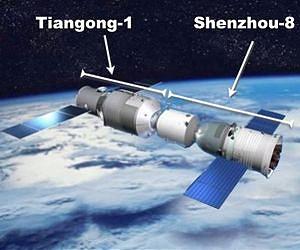
Scientific and medical experiments being carried out onboard space lab module Tiangong-1 are seeing "good progress," according to a senior Chinese space technology expert.
These experiments are largely related to the development of China's aerospace procedures, such as space weather forecasts, Qi Faren, former chief designer of Shenzhou spaceships, told Xinhua on Thursday in an exclusive interview.
Detectors on Tiangong-1 are examining radiations of energetic particles in space to help scientists find ways to avoid the matter's disruption of satellites, he said.
The space module is also set to observe factors that could influence the orbiting of space craft, including Earth's gravity, magnetic field and atmospheric density, so as to help provide more accurate forecasts of the orbit, added Qi.
The expert mentioned that one of the experiments conducted onboard aims to electrolyze liquids on space crafts into oxygen and hydrogen to add oxygen supply, which is seen as preparation for China's future space stations.
There are also experiments that examine possible psychological and physical changes in astronauts in space, and changes in materials under microgravity, Qi went on.
The Tiangong-1 module, launched on Sept. 29, served as a target module to dock twice with the unmanned Shenzhou-8 spacecraft, which completed the mission last year and is now under long-term operation in space.
Qi, a member of the 11th National Committee of the Chinese People's Political Consultative Conference, made the remarks before the annual session of the country's top political advisory body, which is scheduled to open Saturday.
