
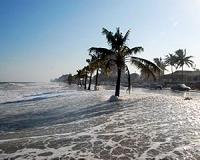
Even if carbon emissions are curbed and rising temperatures are constrained, many scientists expect sea level rise to continue for some time. New research suggests sea level rise could last 300 years.
For some time, climate scientists have argued that some of global warming's impacts have already been baked into the planet's systems. Even if global temperatures stopped rising tomorrow, researchers contend, Earth's ice sheets have already been destabilized, leading to continued melting and sea level rise.
But while the latest efforts of scientists at the Potsdam Institute for Climate Impact Research lend credence to this contention, their findings point to the need for stronger emissions controls.
"Man-made climate change has already pre-programmed a certain amount of sea-level rise for the coming centuries, so for some it might seem that our present actions might not make such a big difference — but our study illustrates how wrong this perception is," Potsdam researcher Matthias Mengel said in a news release.
The goal of the international Paris agreement is to reach the peak in global emissions as soon as possible — a peak followed by an aggressive decline. The latest research, published this week in the journal Nature Communications, suggests the sooner the peak, the better.
"Every delay in peaking emissions by five years between 2020 and 2035 could mean additional 20 cm of sea-level rise in the end — which is the same amount the world's coasts have experienced since the beginning of the pre-industrial era," Mengel said.
Mengel and his colleagues used several of the most advanced climate and sea level rise models to simulate a range of scenarios. All of the simulations operated under the assumption that global emissions restraints will limit warming to 2 degrees Celsius — the aim of the Paris agreement. Each scenario differed, however, in the speed at which the goal is achieved.
The models suggests the planet will experience between 2.3 and 4 feet of sea level rise by the year 2300, but that achieving an emissions apex sooner rather than later will keep sea level rise at the lower end of the spectrum.
Per usual, uncertainty remains. Scientists have struggled to improve the precision of their sea level rise predictions as a result of the complexities of the Antarctic ice sheet.
"The uncertainty of future sea-level rise is at present dominated by the response of Antarctica. With present knowledge on ice sheet instability, large ice loss from Antarctica seems possible even under modest warming in line with the Paris agreement," said Mengel.
And while Mengel's simulations assume the goals of the Paris agreement are met, many climate scientists aren't so confident. Critics of the agreement contend a stronger global commitment to rein in emissions is necessary to meet the warming target of 2 degrees Celsius.
Rising seas could swallow Pacific salt marshes, study suggests
Washington (UPI) Feb 22, 2018 –
Species that rely on the Pacific wetlands for food and shelter could soon be out of luck. According to a new study, sea level rise could swallow up salt marshes along the U.S. Pacific coast by the end of the century.
"The bottom line is, especially in California, most of the salt marsh is going to go away by 2100," Richard Ambrose, a professor of environmental health at University of California, Los Angeles, said in a news release. "Some will go away by 2050."
Ambrose and his colleagues surveyed 14 salt marshes along the Pacific coast, accounting for the physical characteristics of each. The scientists designed models to predict how each marsh would be affected by different sea level rise scenarios.
Under a scenario with limited sea level rise, the impacts would be minimal. Moderate and severe amounts of sea level rise are more likely, however. Under a severe scenario, the marshes would be almost completely wiped out.
But even the predictions under extreme scenarios could be conservative. A recent study found global sea level rise is likely to continue for as many as 300 years after carbon emissions and atmospheric warming peak.
The best scientists can do is offer a range of possibilities and identify the steps communities and governments can take to both prevent and prepare for the worst scenarios.
The new research — published this week in the journal Science Advances — suggests even moderate scenarios could have serious consequences for the communities of plants and animals, including vulnerable fish and birds species, who live in or visit Pacific wetlands.
"We could see an ecological cascading effect," said Glen MacDonald, a professor of geography at UCLA. "If you erase an entire system, the effects are going to ripple upward to predators and downward to prey species. It is just startling."
In other parts of the country, salt marshes can move inland as sea levels rise. But along the Pacific coast, steep rises in elevation and the presence of dense urban development makes the process of wetlands transgression impossible in most places.
In addition to providing shelter and sustenance to birds, mammals and fish, salt marshes also help protect humans from flooding and provide filtration services that keep toxins from moving into inland freshwater systems.
Scientists suggest more must be done to protect the wetlands that remain. UCLA researchers are currently experimenting with sediment deposition to raises the land and protect of salt marshes.
