
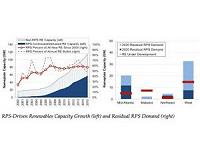
State renewables portfolio standards, known as RPS policies, have contributed to more than half of all renewable electricity growth in the United States since 2000. Most state RPS requirements will continue to rise through at least 2020, if not beyond, and collectively these policies will require substantial further growth in U.S. renewable electricity supplies.
These findings are part of a new annual status report on state RPS policies, from Lawrence Berkeley National Laboratory (Berkeley Lab).
The status report – published in slide-deck form and entitled U.S. Renewables Portfolio Standards: 2016 Annual Status Report – provides a data-intensive review of state RPS policies, highlighting recent legislative revisions, key policy design features, past and projected impacts on renewables development, compliance trends, and costs.
"This document is intended as a progress report to help policy-makers and other electricity industry participants understand the past and future role of state RPS programs – recognizing that they are but one of a number of key drivers affecting renewable energy development in the United States," said Berkeley Lab's Galen Barbose, the report's author.
Mandatory RPS policies require utilities or other electricity providers to generate a minimum portion of their supply from eligible forms of renewable electricity or renewable electricity certificates.
They currently exist in 29 U.S. states plus Washington, D.C., and have been a cornerstone of renewable electricity policy in the United States over the past decade. Additional states have voluntary renewable electricity goals.
