
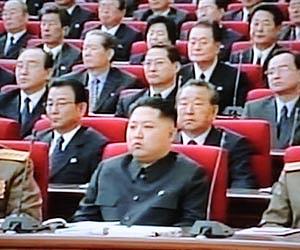
The former US pointman on North Korea voiced doubt Monday that the communist regime would give significant power to young new leader Kim Jong-Un, lowering chances for a resumption of diplomacy.
"Diplomatically, I think it's likely to be a fairly quiet year," Stephen Bosworth, who stepped down in October as the US coordinator on policy toward North Korea, said at the Asia Society in New York.
Bosworth said he believed that diplomacy was the only option on North Korea, which stormed out of six-nation talks on ending its nuclear program in 2009 when it carried out tests of a long-range missile and atomic bomb.
But Bosworth said North Korea's regime was more collective than many believe and doubted leaders would give decision-making power to the untested Kim Jong-Un, who is in his 20s and succeeded late father Kim Jong-Il last month.
"I do not believe that North Korea's engaged in a collective suicide mission. So I don't think that the senior generals and that the senior party people are going to give Kim Jong-Un anything approaching the level of authority that Kim Jong-Il had," Bosworth said.
"I think they need Kim Jong-Un as a figurehead. They need that face on what is… a dynasty," he said.
Despite his doubts of a suicide mission, Bosworth jokingly drew a parallel between North Korea and Heaven's Gate, a UFO cult in California whose members collectively killed themselves in 1997.
"The average North Korean grows up studying juche and venerating the leadership from the age of two on," Bosworth said, referring to the regime's "juche" philosophy of self-reliance.
"I've always tried to sort of think of North Korea as less a political entity and more of a cult. I sometimes refer to them as the Heaven's Gate of international politics," Bosworth said.
"On the other hand, I think there is good evidence that North Koreans now know more and understand better about the gap that exists between their lives and the lives of people in the neighborhood," he said.
Current US officials have also downplayed chances for diplomacy with North Korea during its transition.
President Barack Obama's administration was considering a new engagement drive that could have included US food aid to the impoverished North, but the plan was put on hold after Kim's death.
