
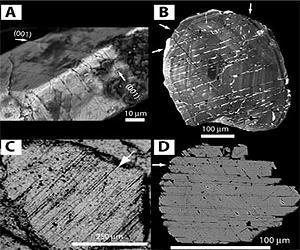
Through NAI's Minority Institution Research Support Program, scientists at the University of Puerto Rico and their collaborators have identified a unique record of an ancient meteorite impact event that is preserved in microstructures in detrital grains of quartz, zircon, and monazite in the Vaal River, South Africa.
The sand samples were collected from the channel of the Vaal River near the two billion-year old Vredefort Dome impact structure, where impact-shocked minerals are known to occur in rocks.
This is the first report that impact shock-deformed minerals survive the process of uplift, erosion, and sedimentary transport.
The unique mineral shock-deformation was documented by scanning electron microscopy at the University of Puerto Rico and the University of Wisconsin. The team's results are published in the current issue of the GSA Bulletin
Abstract
The record of terrestrial meteorite impacts is fragmentary because most impact structures and ejecta are removed by erosion or buried.
Discovery of the missing impact record from Hadean to present may be advanced through identification of residual shocked detritus.
To evaluate which shocked minerals survive erosion and sedimentary transport, we investigated modern sands from the Vaal River in South Africa, where it crosses the 2.02 Ga Vredefort Dome, the largest terrestrial impact structure known to date.
Shocked minerals were identified in all sediment samples, including from the Vaal channel and tributaries within the structure.
In transmitted light, detrital quartz preserves discontinuous decorated planar features previously identified as Brazil twins, which are readily visible as bright, continuous features in cathodoluminescence images.
Detrital zircons preserve five orientations of planar fractures (PFs), which can produce dramatically offset growth zoning and apparent rotation of subgrains.
Other zircons contain filled fractures that may represent a new shock microstructure.
Detrital monazite preserves four orientations of PFs, and many grains contain oscillatory-zoned shocked zircon inclusions, which thus represent shocked inclusions within shocked accessory grains.
Zircon and monazite with granular texture were also identified.
This study is proof of the concept that shocked minerals can be identified in sediments up to 2 billion years after an impact event, and it demonstrates their potential for preserving evidence of ancient impacts.
The recognition of a new geological repository for impact evidence provides a means for identifying distal shocked detritus from eroded structures of any age, and may be particularly relevant to early Earth studies.
Share This Article With Planet Earth
