
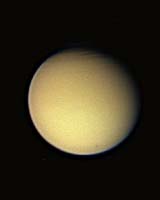
Bringing samples back to Earth has been highlighted as a key priority for future planetary missions in discussion meetings held at the first European Planetary Science Congress in Berlin. Prof. Bernard Foing, Project Scientist for the SMART-1 mission, said, "Europe has now looked at the Moon, Mars and Venus and we have put our finger on Titan.
These are great achievements. But for the future, it is not enough to briefly 'kiss' the surface of other solar system objects. We must bring them back to Earth for analysis."
The European Space Agency (ESA) is in the midst of developing its plans for missions in the medium and long term future. European scientists have been asked to put forward ideas by spring 2007 for ESA's Cosmic Vision programme, which will shape the Science directorate's activities until 2025 and beyond.
Planetary science proposals will compete with ideas for missions from the astronomy, solar physics, solar-terrestrial relations and fundamental physics communities. Planetary scientists are eager to study further how our solar system formed, evolved, and how Earth-like planets and Moons work and can become hospitable to life.
The European Science Foundation also launched a consultation process this week at the EPSC congress in Berlin, in which scientists will be asked for their views on the long term scenario for ESA's Aurora Programme to explore Mars.
In two discussion sessions at the congress, the European planetary science community spoke out, saying the "holy grail" is still a Mars sample return mission but, in the shorter term, realistic ideas for sample return missions from the Moon and asteroids must be discussed.
However, budgets are increasingly tight and sample return missions are expensive. For these ambitious missions to succeed, additional funding will need to be sought.
Michel Blanc, Project Leader for the Europlanet network said, "We need to understand the financial limitations. But if we think creatively, have clear objectives and have a clear voice, we can succeed. We are not just doing this for ourselves but also for the next generation which we are attracting into this fantastic adventure of exploring the solar system."
Europe has a well established record in the study of meteorites and lunar rocks from the Apollo and Russian Luna missions. Laboratories in France, Germany and the UK are also analysing some of the samples returned by NASA's Stardust and Genesis missions.
John Zarnecki, Principle Investigator for the Surface Science Package on the Huygens probe said, "It's important that we build on our recent successes in Europe and plan inspiring planetary missions for the future, both independently and collaborating with other partners around the globe."
