
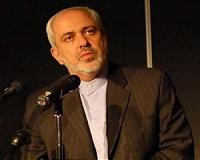
European countries are in "no position" to criticise Iran, Foreign Minister Mohammad Javad Zarif said Sunday ahead of a visit by his German counterpart Heiko Maas.
Germany's top diplomat is due in Tehran on Monday, against a backdrop of Iranian pressure for Europe to uphold commitments made under a 2015 nuclear deal since abandoned by the United States.
"Europeans are certainly in no position to criticise Iran, even about issues that have nothing to do with" the agreement, Zarif said in televised remarks to journalists.
Iran signed the landmark accord with China, Russia, Germany, Britain, France and the United States, leading to sanctions relief in exchange for Tehran curbing its nuclear programme.
But last year, US President Donald Trump walked away from the accord and Washington has since imposed sweeping sanctions on Iran.
European and Western policies "have only caused damage in the region," Zarif said.
"Now some countries like Germany have stopped selling arms to Saudi Arabia for bombarding the people of Yemen, some other countries haven't done so," he added.
"In general, the West has allowed the autocratic regimes in our region to commit crimes."
In May, Iranian President Hassan Rouhani said Tehran would no longer implement some parts of the nuclear deal and threatened to go further if the remaining parties failed to deliver sanctions relief.
Zarif said that Europeans have "a duty" to ensure that Iran's economic relations return to normal.
On Friday Iran rejected an idea mooted by France to re-open nuclear talks, warning that seeking to broaden the existing agreement could lead to its collapse.
Iran rejects French idea of re-opening nuclear talks
Tehran (AFP) June 7, 2019 –
Iran on Friday rejected an idea mooted by France of re-opening nuclear talks, warning that seeking to broaden an existing landmark treaty could lead to its collapse.
President Emmanuel Macron said Thursday that his goal of "regional peace" would require new negotiations, adding that Paris aimed to rein in Iran's nuclear and ballistics activities and its regional influence.
He made the comments at a press conference with US President Donald Trump, who last year withdrew from the multi-lateral agreement known as the JCPOA.
But Tehran's Foreign Ministry Spokesman Abbas Mousavi warned Friday that "bringing up issues that are beyond the JCPOA does not help in saving the JCPOA, but will instead cause increased distrust among the remaining parties" to the deal.
European leaders, bitterly angered by Trump's pullout from the deal in May last year, have struggled to find ways to salvage it in the face of Washington's re-instatement of tough sanctions.
In a statement on the foreign ministry's website, Mousavi said European parties to the deal had been "incapable of acting upon their commitments".
Under such circumstances, he said, making new demands would "only help America in nearing its objective — the collapse of the JCPOA."
The Joint Comprehensive Plan of Action was an agreement between world powers including France and the United States, offering Iran sanctions relief in return for curbs on its nuclear programme.
Iran had until recently remained in full compliance with the deal, but with the remaining parties struggling to bypass US sanctions, Tehran has reaped few of the promised benefits.
In May, it dropped its adherence to certain limits on enrichment activities under the accord and gave an ultimatum to the remaining parties that it would ditch other commitments unless they delivered on promised sanctions relief.
Trump's administration has also sought tighter controls on Iran's ballistic missile capabilities.
In comments published by the Washington Times on Friday, Secretary of State Mike Pompeo demanded that Iran bring its missile programme "back inside a set of constraints" laid out in UN Security Council Resolution 2231.
Iran's Foreign Minister Mohammad Javad Zarif hit back, tweeting that the US had "violated" the same resolution by withdrawing from the nuclear deal and was "in no position to push a conceited interpretation of its missile provision".
He pointed out that the resolution called on Iran "not to undertake any activity related to ballistic missiles DESIGNED to be capable of delivering NUCLEAR weapons."
"Our missiles are not 'designed' for nukes, which we're not developing," he said.
Japan's Abe set for mediation mission to Iran
Tokyo (AFP) June 6, 2019 –
Shinzo Abe plans to travel to Iran next week, the first visit by a Japanese prime minister in more than four decades, as Tokyo hopes to ease Middle East tension by mediating between Washington and Tehran.
A government official told AFP that Tokyo was still arranging details, including who Abe will meet, but local media have said he will hold talks with Iran's Supreme Leader Ayatollah Ali Khamenei and President Hassan Rouhani.
As tensions intensify between Iran and Japan's key ally the United States, Abe has reportedly proposed serving as a go-between by directly holding talks with Iran's key leaders.
"We believe it is extremely important that, at the leadership level, we call on Iran as a major regional power to ease tension, to adhere to the nuclear agreement and to play a constructive role for the region's stability," Chief Cabinet Secretary Yoshihide Suga told a regular press briefing.
The visit, from June 12-14, will be the first by a Japanese leader in 41 years, Suga said.
During his state visit to Tokyo in late May, US President Donald Trump said he remained open to talks with Tehran, appearing to give the green light to Abe's plan.
Abe told a news conference with Trump: "By closely cooperating between Japan and the US, I would like to help ease the current tension surrounding the Iranian situation."
Japan and Iran have maintained a good relationship as resource-poor Japan relies heavily on imports of oil from the Middle East, though crude from Iran accounted for just 5.3 percent of the country's total imports last year.
On the other hand, Iranian and US leaders have ratcheted up barbs and insults ever since Trump was elected as president in 2016.
Living up to his campaign promises, Trump withdrew the US in May 2018 from the landmark 2015 nuclear deal between Iran and major world powers, and reimposed sanctions.
The war of words intensified after Iran's revolutionary guards were designated a "terrorist organisation", with Tehran hitting back by declaring the US a "state sponsor of terrorism" and Washington's forces in the region "terrorist groups".
Fears the war of words could flare into a military clash escalated when Washington dispatched the USS Abraham Lincoln carrier group, an amphibious assault ship, a Patriot missile battery and B-52 bombers to the region.
