
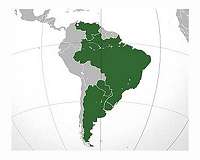
The trade deal signed on Friday between the European Union and the South American trade bloc Mercosur — Brazil, Argentina, Uruguay and Paraguay — includes guarantees to counter possible negative effects.
Here are the main points of an agreement covering some 770 million people who currently exchange 88 billion euros ($100 billion) in goods annually.
– Customs rights –
Under the deal, 91 percent of customs duties on European imports into the Mercusur countries will eventually be scrapped, which the EU Commission estimates to be worth 4.0 billion euros.
In return, the EU will abolish 92 percent of duties currently imposed on South American countries coming into Europe.
In the industrial sector, Mercosur will progessively eliminate customs duties on cars (35 percent), detached parts (14-18 percent), industrial equipment (14-18 percent), chemicals (up to 18 percent), clothing (up to 35 percent) or pharmaceutical products (up to 14 percent).
– Agriculture –
On agricultural products, the Mercoscur bloc will eliminate its taxes on wine (27 percent), chocolate (20 percent), spirits (20-35 percent), biscuits (16-18 percent), tinned peaches (55 percent), carbonated drinks (20-35 percent) and olives.
As for the EU's cheeses and dairy products, EU Agriculture Commissioner Phil Hogan says they will benefit from "large quotas" without taxes.
In return, the EU will open its markets to South America agricultural products — in its biggest concession — via quotas: 99 tonnes of beef per year at a preferential rate of 7.5 percent, a supplementary quota on 180,000 tonnes of sugar and another one on 100,000 tonnes of poultry.
– Safeguard –
The deal entails a "safeguard mechanism" which allows the EU and Mercosur to impose temporary measures to regulate imports in case of unexpected and significant increases likely to harm their respective sectors. The guarantees apply to agricultural products.
– Protected designation of origin –
Mercosur has vowed to protect 357 European "geographical indications" such as Parma ham, champagne, port or Irish whiskey.
The EU will also protect a number of South American designations such Brazilian cachaca or Argentinian Mendoza wine.
– Health –
The European Commission promises that "nothing in the agreement changes the way in which the EU adopts and applies its rules on food safety," whether the products be of European origin or imports.
The deal contains a reference to a "principle of precaution", guaranteeing that the public authorities can "act to protect human, animal and vegetable health, or the environment, in face of a perceived risk, even if scientific analysis isn't conclusive."
– Environment –
The deal contains a chapter on sustainable development that covers "the sustainable management and conservation of forests, respects for workers' rights and the promotion of responsible commercial conduct."
It makes explicit reference to the Paris climate accord.
According to the Commission, both sides are committed to "fighting climate change and negotiating a transition to a sustainable low-carbon economy.".
This included a "committment to fighting deforestation", which is an important point for NGOs who accuse Brazil of destroying the Amazonian rain forests.
The Commission also said the chapter "will include clear and rigorous rules, as well as a mechanism for independent and impartial evaluation of these issues by a group of experts," without providing any details.
– Public sector –
The Mercosur countries will open up their public sector to European companies, a decisive advance for the EU.
In concrete terms, EU companies will be able to take part in tender offers on an equal footing with Mercosur companies.
