
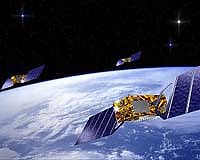
The European Space Agency (ESA) and Galileo Industries signed Thursday a 1.5-billion-euro (1.8-billion-dollar) contract for the delivery of four satellites to be used in an ambitious navigation system that Europe hopes will rival the reigning US GPS network.
ESA and the Galileo consortium officially signed the contract for delivery of the four satellites, which are to be followed by a further 26 satellites between now and 2010.
Europe's Galileo project is estimated to cost a total 3.8 billion euros.
Unlike GPS, which is controlled by the US military, Galileo will stay under civilian control, increasing the European bloc's strategic independence from the United States. And the new system, which will be in commercial operation by 2010, will be more accurate than GPS, giving mariners, pilots, drivers and others an almost pinpoint-accurate navigational tool.
"Satellite navigation will offer absolutely infinite possibilities for use," German Transport Minister Wolfgang Tiefensee said after the signing.
The head of Galileo Industries, Guenter Stamerjohanns, said the deal marked a key step for the project. ESA director general Jean-Jacques Dordain called the contract "one of the most important ever signed between industry" and the agency.
The four satellites are to be sent into orbit in 2008.
The first Galileo test satellite, GIOVE-A, blasted off from Kazakhstan on a Russian rocket in December on a mission to try out equipment, including an atomic clock, in preparation for future phases of the project.
It has already sent back the first signals and is to be succeeded in April by GIOVE-B. The first commercial use of the system is expected in 2010.
Germany, which is the largest contributor to the project with 500 million euros, had long refused to contribute more to the project because it said it did not see enough commercial applications for local companies.
Galileo Industries responded by basing one of its control centers in the southern German town of Oberpfaffenhoffen.
The head of the German aircraft and space industry association, EADS co-president Thomas Enders, welcomed the deal, saying that "jobs and know-how will be maintained and created in Germany".
Source: Agence France-Presse
