
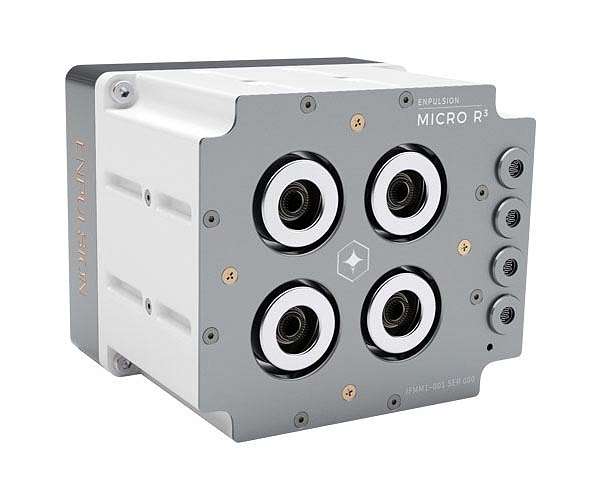
Thrusters from the new ENPULSION MICRO family are based on the FEEP technology of the NANO family, which has a notable flight heritage with more than 50 units in space by September 2020. This proven flight technology is now scaled to significantly more power. The ENPULSION MICRO R3 produces up to 1.2 mN of thrust with an input power of 120 W and provides up to 50 kNs of total impulse, which makes it particularly adapted to small and medium size spacecraft.
It can be launched safely on any rocket as it contains no pressure vessels or energetic chemical. The thruster and propellant are all contained in a 14x12x10 cm (14x12x13 cm with PPU) module bolted directly to any flat panel. No accommodation for a separate tank or fluid piping is required.
The ENPULSION MICRO R3 is inherently redundant with more than a 100 parallel ion emission sites and 4 cold redundant neutralizers. Its high specific impulse and the unrivaled control precision are perfect for station keeping and attitude control.
End-of-life operations can be performed at the most optimal operation point depending on remaining propellant quantities. The design incorporates lessons learned from many acceptance tests and in-orbit performances of the ENPULSION NANO.
All products from the ENPULSION MICRO family use radiation tested (TID and SEE) electronics for increased reliability. Thrusters are procured in lot-controlled batches.
Selected sets of these batches are subjected to radiation testing, so that each thruster delivered to a customer can be traced back to a fully representative qualification model using components from the same batch. The thruster is assembled into a protective casing that shields the electronics from the hazardous space radiation environment, facilitates handling during integration, and allows side mounting.
"We see this as a major milestone in the company's development", said Dr. Alexander Reissner, CEO of ENPULSION. "The MICRO is the result of many years of product development and will allow us to reach a new group of customers with our reliable and tested propulsion technologies."
