
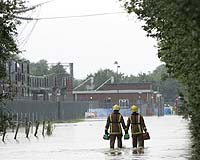
Britain's emergency contingencies committee met Monday night to discuss further measures to combat the worst flooding in 60 years, which Prime Minister Gordon Brown linked to climate change. Large swathes of central and western England were submerged as rivers swelled and burst their banks during four days of heavy and persistent rain, leaving thousands without clean water or electricity and facing the prospect of more rain.
There was some good news, however, as water levels appeared to have peaked below a level which would have flooded a power station servicing half a million homes.
The largely rural counties of Gloucestershire, Worcestershire and Oxfordshire were the worst hit, forcing Royal Air Force (RAF) helicopters to evacuate around 150 people in its biggest-ever peacetime rescue.
Britain's COBRA government emergency planning committee met Monday evening and was chaired by Environment Secretary Hilary Benn amid concerns that an electricity sub-station in Gloucester would be flooded.
Fortunately for residents of the area, the Environment Agency (EA) said that the River Severn had reached a peak there, just two inches (5 centimetres) below the main wall protecting the city centre and the power station.
The EA also said that water levels in many of the worst-hit parts of Britain were set to peak Monday night and Tuesday.
Speaking after a helicopter visit to the area, Brown linked the floods to climate change and pledged 200 million pounds (298 million euros, 411 million dollars) extra funding, plus a review to address future issues.
Britain was grappling with "19th century structures" and its drainage system would also have to be looked at, he added.
Benn earlier told parliament that up to 10,000 homes have been or could still be flooded and warned that the emergency was "not yet over".
In Gloucestershire, the worst-hit area, at least 150,000 homes were without water after a treatment works flooded, while 40,000 were without power.
It could take up to two weeks to restore water supplies to some households, according to some reports.
Officials earlier expressed fears that Britain's two biggest rivers, the Thames and the Severn, could burst their banks, with more chaotic results for homes and businesses.
London is not expected to be affected by the flooding, despite the fact that the Thames runs through it.
In the university city of Oxford, which is on the Thames, up to 1,500 people have already been evacuated to a football stadium amid widespread inundation and the closure of scores of schools.
Rail services across the affected area were paralysed while many roads were also impassable.
Meanwhile, facilities at Britain's Atomic Weapons Establishment (AWE) sites in Aldermaston and Burghfield were affected as a sewage plant flooded on one of the sites, though tests carried out on flood water for potential radiation contamination revealed none.
The Association of British Insurers has predicted that the cost of this bout of flooding, combined with one last month which killed four people, could be over two billion pounds (2.9 billion euros, 4.1 billion dollars).
Source: Agence France-Presse
