
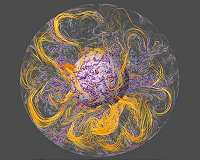
The Earth's magnetic field, or geomagnetic field, is the magnetic field that extends from the Earth's interior out into space. This field interacts with the stream of charged particles emanating from the Sun, known as the solar wind.
This magnetic field is sustained by electric currents generated from the motion of convection currents of molten iron in the Earth's outer core. The convection currents are caused by heat escaping from the planet's core.
The magnitude of this field at the Earth's surface ranges from 25 to 65 microteslas. Although the magnetic fields geometry is quite complex it can be simply approximated by the field of a magnetic dipole tilted at an angle of about 11 degrees with respect to Earth's rotational axis.
Imagine a large bar magnet placed at a 11-degree angle to the Earth's polar axis at the center of the Earth. The northern geomagnetic pole is located near Greenland, but it is currently the south pole of the Earth's magnetic field, and conversely.
While the north and south magnetic poles are usually located near the geographic poles, they slowly andcontinuously drift over very-long time scales. Drift rates are sufficiently slow that ordinary compasses can be used for navigation.
Strangely and at irregular intervals, the field reverses such that the north and south magnetic poles flip. This phenomenon has been detected by paleomagnetists who have studied magnetic properties in rocks and have concluded that reversal events apparently occur every several hundred thousand years or so.
The existence of the magnetic field has proven quite fortuitous because this field extends several tens of thousands of kilometers into space. In effect, this magnetosphere protects the Earth from charged particles in the solar wind and cosmic rays that would strip away the upper atmosphere and the protective ozone layer.
