
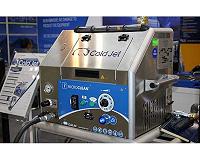
Making homemade root beer and freezing tennis balls may rank as a few of the recreational uses for solid carbon dioxide, also known as dry ice, or solid CO2. But its industrial use as an efficient and safe cleaning agent has emerged as an important tool amid increasing sensitivity over the environment.
Marketers at Cold Jet are hopeful that the technology of dry ice blasting – the fastest growing industrial application of the material – will someday catch on in Japan. The Ohio-based company pioneered and patented modern single-hose dry ice blasting technology in 1986.
Dry ice blasting typically works by flashing pressurized liquid CO2 into snow at around minus 78.5C, or by shaving blocks of ice, compressing the material into pellets, then using air to shoot them at supersonic speeds to the target area. The cleaning process has two phases: through kinetic energy when the pellets impact a soiled surface, and when the dry ice further loosens any soiling through sublimation. The subliming effect leaves no waste.
The technique has spread globally over the last three decades, and is used to clean food processing equipment, decontaminate surfaces of microorganisms, scrub rubber and plastic molds, remove grime and debris from milled and machined metal, and to safely cleanse electronic components.
At Cold Jet, pellets can be engineered to fit the job, from 0.3mm up to 19mm, while hose pressures can be set up to 300 PSI (pounds per square inch).
"Of course, I'm biased, but there is little to not like about dry ice cleaning," says Lan Jin, marketing manager at Cold Jet's office in Tokyo. "Unlike sand, soda, beads, and steam, there's no pitting or damage to underlying surfaces, no fire or electrical hazards, and zero toxicity."
Tightening anti-pollution laws are making it tougher to use dangerous chemicals, she adds. "Best for the environment is that dry ice sublimates almost immediately, leaving nothing to clean up. And it's not like we're adding CO2 to the atmosphere; we're merely returning it."
Despite wide adoption in the U.S. and Europe, the technology has had an inexplicably hard time selling in Japan and most of Asia, however. On the surface, at least, the high-tech manufacturers concentrated in the region would seem like perfect clients for such gear.
"The (dry ice) tech is undeniably effective, and while there has been some recognition of dry ice cleaning in Japan, it's been modest," says Osaka-based hybrid dry ice blasting developer White Wolf in an industry commentary. It speculated that for portable dry ice systems, compressor size (35hp), weight (100kg), noise level (upwards of 100db), and cost (around 2,000,000 yen + accoutrements) might be too much for many companies to bear.
New technologies sometimes take time to take hold, however. Fifteen years ago, the UK was another region slow on dry ice adoption, even as the rest of Europe appeared to race ahead, says Ian Reynolds, managing director at Optimum Dry Ice Blasting, in a LinkedIn post. After doing initial market research on a dry ice system in the early 2000s, he initially decided that the ROI (return on investment) would take too long.
"Roll on 10 years and we now have a very different perspective; UK industry has finally woken up. The old guard are retiring and the new breed are open for change," he says. "Reduce downtime, increase production; it's a simple economy."For his business, dry ice systems halved post-production costs in half while cutting equipment down time from two days to five hours.
Japan's food industry, notorious for its attention to sanitation, could be another prime candidate for the technology, as wet cleaning is often problematic in bakeries, refrigeration equipment, ovens, walls, and floors.
"Since water is most often used for cleaning, there is the near inevitability that any water that goes undried will lead to microbial growth. Not only does dry ice avoid this whole conversation, but goes a step further by sanitizing them as well," says Food Safety Magazine.
The technology has also gotten a boost from disaster. Five years after the Fukushima Nuclear Power Station meltdown, robots are playing an ever-increasing role in the decommissioning and decontamination of the plant, according to local press and reports from Tokyo Electric Power Co. (TEPCO). There, unmanned vehicles designed by Mitsubishi, Hitachi-GE, and Toshiba Corp. are employing dry ice blasting inside the stricken facilities to remove hazardous materials.
