
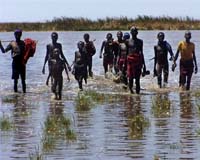
A vicious cycle of drought and floods is continuing to bring death and misery to millions of impoverished people across east Africa, the United Nations said Friday. After months of a scorching killer drought that threatened more than 11 million mainly rural peasants and pastoralists with starvation, heavy rains have pounded the region, causing deadly flash floods in six countries, it said.
Since July, nearly 1,000 people have been killed and more than 100,000 others displaced as raging flood waters have swept over parched land in Ethiopia, Sudan, Eritrea, Somalia, Kenya and Uganda, it said.
"Thousands of people are in need of urgent humanitarian relief as entire communities have been displaced, disrupted, bereaved, and have lost vital livestock and farmland," the UN Office for Coordination of Humanitarian Affairs (OCHA) said.
"The natural, cross-border lay-out of river systems, lakes and the man-made system of dams add a regional dimension to the ongoing crisis affecting some of the most vulnerable communities on the continent," it said in a statement.
Compounding the problems, recent floods are affecting countries recovering from chronic conflict, weakening government disaster response mechanisms and forcing aid agencies and survivors to do the bulk of rescue work, OCHA said.
Worst-hit is Ethiopia, where swollen rivers and flash floods have killed at least 639 people and displaced tens of thousands in the south, north and east since the beginning of August.
Relief efforts have been hampered by unusually heavy seasonal rains that are preventing emergency workers from reaching affected areas and raising the already heightened risk of the spread of water-borne diseases, it said.
In Ethiopia, there are fears the floods will exacerbate a diarrhoea outbreak that has killed at least 156 people and sickened more than 15,500 since, according to the UN children's agency UNICEF.
"The floods are creating conditions for it to spread rapidly," UNICEF Emergency Planning Officer Susan Ngongi said. "If it is not detected quickly and treated quickly, it kills fast."
"All flood affected areas will need surveillance to minimize the spread of diseases that accompany the flood situation," OCHA warned in the statement.
Floods are common in the region during the July to Sepember wet season, when moisture-laden Indian Ocean winds change direction and bring heavy rains to the Ethiopian highlands, but this year's have been particularly disastrous.
The torrential rains there have sparked floods not only in the lowlands but have swollen rivers to the breaking point to the south, east and west, hitting neighboring Kenya, Somalia and Sudan as well as Uganda.
In northern Kenya, an area that just months ago was the epicenter of a searing drought that led to the deaths of dozens, flash floods have killed at least six people and displaced hundreds, the UN said.
In Somalia, rivers have flooded, compounding the effects of heavy rains in Mogadishu flooded earlier this week, drowning at least five people and leaving thousands, many of whom had fled drought-hit areas in the south, homeless anew.
Flooded rivers in eastern Uganda have killed three people and washed away large numbers of homesteads, displacing thousands, the UN said.
Meanwhile in southern and eastern Sudan, the flooded Nile River has displaced at least 24,000 people and damaged more than 10,000 hectares (24,700 acres) of farmland, it said.
Eritrea has reported receiving its heaviest rains in 11 years, that have displaced hundreds of people currently being sheltered in schools, according to OCHA.
Source: Agence France-Presse
