
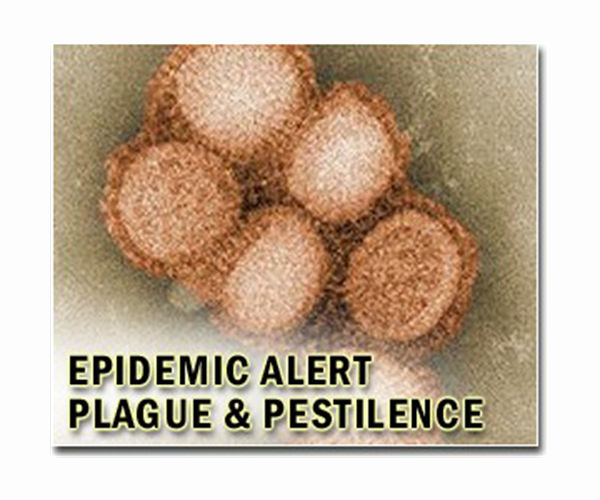
Dozens of people in China have fallen ill with a new virus that is also found in shrews, a report has said, but there is so far no evidence of human-to-human transmission.
The infections were found in China's eastern Shandong and central Henan provinces, affecting 35 people, according to a report in the New England Journal of Medicine this month.
The virus is called Langya henipavirus or LayV, and patients reported symptoms that include fever, fatigue, cough, nausea and headaches.
Some people also developed blood cell abnormalities and impaired liver and kidney functions, the report said.
Research findings suggested shrews may be a natural reservoir for the pathogen.
"There was no close contact or common exposure history among the patients, which suggests that the infection in the human population may be sporadic," according to the report.
But it also cautioned that its sample size "was too small to determine the status of human-to-human transmission for LayV".
Patients were mostly farmers and cases were found with help from a detection system for people with acute fever and a history of animal exposure, it added.
Further investigation is needed to better understand illnesses associated with the virus, according to the researchers in China, Singapore and Australia who were involved in the paper.
Cases of Langya henipavirus have so far not been fatal or very serious, Linfa Wang of the Duke-NUS Medical School in Singapore, told Chinese state outlet Global Times.
Wang was one of the researchers involved in writing the paper.
Zoonoses are animal diseases that transmit to humans, and comprise a large percentage of new and existing diseases in people, according to the World Health Organization.
Some are preventable through vaccination, while others mutate into human-only strains or cause recurring outbreaks.
Chinese medical portal censored after doubting herbal 'Covid remedy'
Beijing (AFP) Aug 11, 2022 –
A popular Chinese medical information site has been censored by authorities for "violation of relevant laws and regulations", months after its criticism of a government-backed herbal Covid-19 treatment sent shares in a pharmaceutical giant tumbling.
DXY, which counts tech giant Tencent among its investors and runs a host of health-related services, previously questioned the value of Lianhua Qingwen, a herbal remedy marketed for fever and sore throats, as a Covid-19 treatment.
China approved the concoction — made up of ingredients like honeysuckle and apricot seeds — as a Covid-19 treatment in 2020, and it was distributed to Shanghai residents during the city's outbreak this year.
DXY's article, which has now been deleted from its website, was part of a wave of reports that caused shares in Lianhua Qingwen's producer — one of China's largest traditional medicine companies — to plunge.
The website has now been banned from posting on at least five of its Weibo social media accounts, with a notice at the top of its official page saying that due to "violation of relevant laws and regulations, this user is currently prohibited from posting".
DXY's official WeChat accounts, which typically publish multiple articles a day on medical topics, have not been updated since Monday.
The Weibo notice did not specify which regulations had been violated by DXY, which did not immediately respond to AFP's request for comment.
– 'No right to ban them' –
The Chinese government has increasingly promoted traditional medicine at home and abroad in recent years, often with nationalistic undertones.
DXY's coverage prompted criticism that it was targeting traditional Chinese medicine (TCM) in order to promote Western pharmaceuticals.
The decision to freeze DXY's social media accounts was lauded by some Weibo users, who accused the company of working with "anti-China forces" and peddling false information.
"For this vicious thing eating the anti-Chinese capitalists' dog food, the best days are in the past," one Weibo user wrote.
But others lamented the loss of a valued source of misinformation-free medical guidance and said they disagreed with the censorship.
"My mother used to be the kind of person who would make her kids eat chicken gallbladder for fevers," one wrote, crediting DXY with giving her parent access to modern medical information.
"You have the right to (criticise) DXY on Weibo, but you don't have the right to ban them," the user wrote.
The United States and other countries have warned there is no evidence Lianhua Qingwen works to prevent or cure Covid-19, even as it has increasingly been promoted by government authorities in China and Hong Kong.
The US Food and Drug Administration has said it has not approved Lianhua Qingwen and that coronavirus-related claims about it were "not supported by competent and reliable scientific evidence".
Beijing issued its first white paper on TCM in 2016, laying out plans to build medicine centres and dispatch practitioners to developing countries in Africa and Southeast Asia.
President Xi Jinping has described TCM as a "treasure of Chinese civilisation" and has said that it should be given as much weight as other treatments.
Beijing's National Health Commission has also dispatched TCM practitioners as part of its medical reinforcement teams sent to fight Covid-19 outbreaks across the country.
