
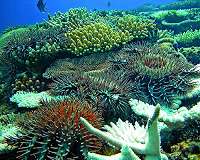
Genetic analysis of fish feces suggests crown-of-thorns starfish are a surprisingly popular menu item. According to the findings, published Monday in the journal Scientific Reports, several popular commercial fish species, found in both aquariums and the grocery store, snack on the reef-eating starfish.
The crown-of-thorns starfish isn't invasive, but it is a pest. Since 1962, the species' numbers have exploded three times, decimating coral reefs.
Ecologists and conservationists have long sought to bolster starfish predator populations as a way to protect reefs, but until now, the giant triton mollusk was the only species known to consistently prey on crown-of-thorns.
To see whether other species also eat the starfish, researchers at the Australian Institute of Marine Science analyzed DNA in fish feces over the course of three years. Scientists were able to identify a genetic marker specific to crown-of-thorns. The fish poop was collected from 678 fish, comprising 101 species and 21 families.
Samples were retrieved from reefs with varying levels of crown-of-thorn populations — some relatively undisturbed, others in the midst of an outbreak. Researchers published earlier this year showed the devastation caused by crown-of-thorns can appear suddenly, thanks to the species ability to delay its dietary switch from algae to coral.
The DNA data showed at least 18 coral reef fish species feed on the problematic starfish, including the spangled emperor, redthroat emperor and blackspotted puffer.
"Our results strongly indicate that direct fish predation on crown-of-thorns may well be more common than is currently appreciated," lead researcher Frederieke Kroon said in a news release.
Half of the 18 species identified by the new species are fish not previously observed eating crown-of-thorns starfish, including the neon damsel, redspot emperor and the blackspot snapper.
"Our findings might also solve a mystery — why reef areas that are closed to commercial and recreational fishing tend to have fewer starfish than areas where fishing is allowed," said Kroon.
Authors of the new study hope their findings will inform improved reef conservation strategies and help prevent future crown-of-thorns outbreaks.
"This innovative research sheds new light on the extent that coral reef fishes eat crown-of-thorns starfish," said Darren Cameron, director of the COTS Control Program at the Great Barrier Reef Marine Park Authority.
"A number of the fish species shown to feed on these starfish are caught by commercial and recreational fisheries, highlighting the importance of marine park zoning and effective fisheries management in controlling crown-of-thorns starfish across the Great Barrier Reef," Cameron said.
