
In the wake of the devastating Great East Japan Earthquake in 2011, scientists from Yokohama National University have unveiled novel insights into the protective capabilities of coastal forests against tsunamis. The research, published in the 16 October issue of Natural Hazards, presents a compelling case for the superior resilience of mixed-species forests over monoculture forests, particularly those exclusively comprising black pine (Pinus thunbergii).
Historically, Japan's coastal areas have been afforested predominantly with black pine, a species known for its endurance in dry, harsh coastal environments. This practice, dating back to the Edo period (1603-1867), initially aimed to shield the coastlines from strong winds and sand blowing. However, the catastrophic tsunami triggered by the Great East Japan Earthquake, which impacted 2,800 hectares of coastal forest, has shifted the focus towards understanding how these forests mitigate the destructive force of tsunamis.
Yuki Iwachido, the first author of the study and an assistant professor at Yokohama National University, emphasized the importance of this research. "Prior studies have established that coastal forests decrease the hydrodynamic forces exerted by tsunamis on structures and alter inland debris dispersion based on the density and size structure of trees. However, limited attention has been devoted to exploring the role of species diversity in coastal forests," Iwachido stated.
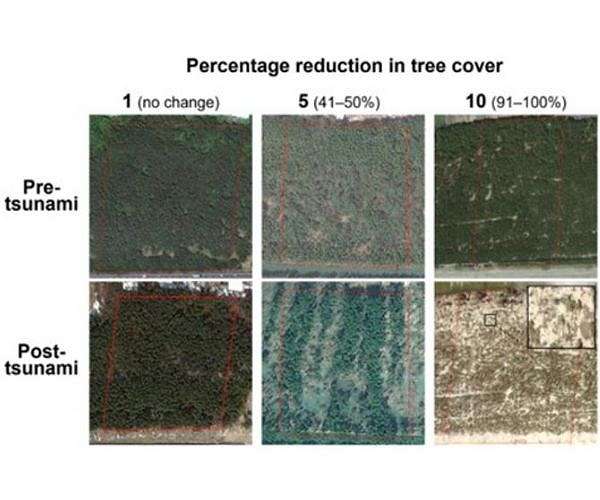
The research team embarked on a detailed analysis of satellite images and aerial photographs of coastal forests, comparing the extent of damage in areas with monospecific black pine forests to those in mixed forests comprising black pine and other broad-leaved tree species. Their findings suggest that mixed forests fared significantly better in withstanding the tsunami, presumably due to the varied root morphologies of different species efficiently utilizing soil space and resources, thus potentially enhancing the overall stability of these forests.
Notably, the study also highlighted the advantages of complex tree planting arrangements over simpler ones. Forests with intricate spatial structures seemed more adept at resisting tsunami forces, as suggested by the visual impact analysis post-tsunami.
Despite these promising results, the researchers acknowledge the limitations of their study. One key constraint was the inability to compare the outcomes with a monoculture of broad-leaved trees, hence not fully isolating the impact of coniferous trees like black pine. Takehiro Sasaki, senior author of the study and a professor at Yokohama National University, underlined the need for further research. "This study primarily focused on analyzing only damage patterns to coastal forests caused by tsunami impacts utilizing satellite images. There is a pressing need to elucidate the mechanisms by which mixed coastal forests alleviate the impacts of tsunamis," Sasaki explained.
The research, also involving Minori Kaneko from the Graduate School of Environment and Information Sciences at Yokohama National University, signifies a crucial step towards enhancing our understanding of the role of diverse coastal forests in natural disaster mitigation. As the world grapples with increasing environmental challenges, such findings could be instrumental in informing future coastal forest management strategies, potentially redefining our approach to safeguarding coastal communities from the devastating impacts of tsunamis.
Research Report:Mixed coastal forests are less vulnerable to tsunami impacts than monoculture forests
