
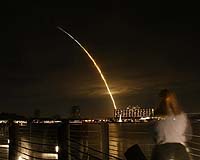
The seven astronauts on the space shuttle Discovery on Sunday began a challenging twelve-day mission involving some of the most complicated construction work ever performed on the International Space Station. After a spectacular nighttime lift-off, Discovery made its way toward its Monday rendezvous with the ISS, with three space walks planned to rewire the station's electrical system and install a new 11-million dollar truss.
Late Saturday, the shuttle blasted off in a cloud of white smoke and flame, reaching orbit about nine minutes later in the first night launch since Endeavour lifted off on November 23, 2002.
"What you've seen this evening was the successful accomplishment of the most challenging, demanding technically state of the art difficulty thing that this nation, or any nation can do and today this team accomplish it successfully, it's an extraordinary event," Michael Griffin, head of the National Aeronautics and Space Administration, told reporters.
Launch administrator LeRoy Cain said he "can't be happier about the performance of the team and the vehicle."
"It's a great day in manned space flight," he added.
In the wake of the February 2003 Columbia accident, night launches had been suspended to ensure adequate lighting to detect any launch debris that might endanger the shuttle.
A piece of foam insulation that peeled off Columbia external fuel tank sliced a hole in that shuttle's left wing, ultimately dooming it and its seven-member crew.
NASA engineers and managers said they now feel confident that Discovery's rockets can provide sufficient illumination during night launches.
Discovery's two rocket boosters successfully separated from the orbiter two minutes after blasting off from the Kennedy Space Center, and the shuttle later jettisoned its massive external fuel tank.
On Sunday, the crew was to inspect the payload bay doors, set up computers and other equipment, check out the shuttle's robotic arm and begin heat shield inspections.
NASA's confidence has been boosted by two nearly flawless missions this year, as the US space agency races to finish the ISS by 2010, when the shuttle fleet, down to three orbiters, is to be retired.
While shuttle missions in July 2005 and July 2006 focused on improving safety, a September 2006 launch marked the resumption of ISS construction as seven astronauts on board shuttle Atlantis brought a pair of solar panels to increase the outpost's power capacity.
"I hold my breath every time we do spacewalks because you never know what can happen," said mission commander Mark Polansky. "So I'll definitely be watching. But I don't think I'll be as worried as the guys in Mission Control and the folks who have been working on the hardware will be."
The solar arrays installed in September will be activated in the Discovery mission.
The current mission is among 14 NASA has planned to finish the ISS over the next four years.
NASA considers the orbiting laboratory a key part of its space exploration ambitions, which include returning astronauts to the moon and eventually setting foot on Mars.
The Discovery crew comprises two women and five men, including Stockholm physicist Christer Fuglesang, Sweden's first astronaut.
The other astronauts, all Americans, include US Navy commander Sunita Williams, whose father is from India.
Formerly a navy test pilot, Williams, 41, is a flight engineer on the mission and will stay behind for a stint on the ISS.
Polansky, the 50-year-old mission commander, served as a pilot on a 2001 shuttle flight.
His co-pilot is William Oefelein, 41, who is making his first journey into space.
The rest of the crew includes mission specialists Robert Curbeam, Joan Higginbotham and Nicholas Patrick.
Source: Agence France-Presse
