
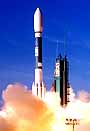
The successful launch of five Iridium system satellites aboard a Boeing Delta II rocket completed 50 percent of the planned global mobile telecommunications network.
"Getting the first half of the Iridium constellation up is an
exciting landmark for us," said Mark Borota, Motorola Satellite
Communications Group. "Boeing has been an invaluable team member.
Their willingness to work with us to meet our goals has been
essential in reaching this milestone."
The Boeing Delta II expendable launch vehicle rocketed off the
pad at Vandenberg Air Force Base (VAFB), Calif., at 6:23:36 p.m.
PDT, within the five-second launch window necessary to place the
satellites into coordinated orbits with the rest of the constellation. In four launches this year, Delta II rockets have carried 20 Iridium satellites into space.
Delta rockets, which have been launched 248 times since 1960,
have historically launched civil and military spacecraft. From
1991 through 1994, 35 percent of Delta II launches carried
commercial payloads. However, with a growing worldwide demand
for reliable launch vehicles to deliver telecommunications
satellites, the Delta program is expanding to meet the requirements
of the market place. The Delta II, which was brought into service
in 1989, has a success rate of 97 percent, making it the world's
most reliable expendable launch vehicle.
"With the increased demands of the telecommunications market, 60
percent of our launches since January 1995 have carried commercial
payloads," said Jay Witzling, division director of Boeing Delta
and Titan programs. To meet the increased requirements of
commercial customers, Boeing developed the Delta III, the next
generation of Boeing expendable launch vehicles. The Delta III
will make its maiden flight in the spring of 1998 carrying a
Hughes Galaxy X communications satellite.
