
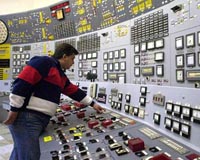
Part of the protection system of a relatively new reactor at the controversial Kozloduy nuclear power plant in Bulgaria was found to be defective when a minor accident occurred in March, Kozloduy director Ivan Ivanov said Tuesday.
The Bulgarian government has reached a deal with the European Union to mothball four of the six reactors at Kozloduy, which supplies 42 percent of the country's energy. The closure of the four oldest Soviet-design reactors, for safety reasons, was a precondition set by Brussels for starting EU membership talks with Sofia.
The defect discovered in March was detected in one of the two remaining reactors. The EU has not expressed security concerns about these.
Ivanov said the defect had come to light during a failure on March 1 of the electricity circuit support system of the main coolant pump of reactor five. That prompted authorities to shut the reactor down pending repairs and security checks, he said.
During preparation for switch-off the operator saw that "22 out of the 62 control rods did not work" but "there was no danger whatsoever of an explosion", Ivanov said.
"We noticed the defect and proceeded towards switching off the reactor. The protection system still had the necessary capacity," he added.
Ivanov said the accident had been minor, ranking at level one or "anomaly" on the International Nuclear Event Scale (INES), which has seven levels ranging from zero (no safety significance) to seven (major accident).
His statement on bTV private television came in reaction to a comment made by another Bulgarian nuclear expert, Georgy Kaschiev, who called the number five reactor "a train without an emergency break".
Kaschiev said "there was a massive failure of the protection elements, unprecedented in the whole history of nuclear energy (use)" that corresponded to a "level two or three incident" on the INES scale.
Kaschiev, who now works at the Institute of Risk Research at the University of Vienna was sacked in 2001 as head of the Bulgarian nuclear regulatory authority after criticizing "a disturbing tendency for degradation of security" at the plant.
Economy and Energy Minister Rumen Ovcharovalso reacted Tuesday to Kaschiev's statement, qualifying it as "speculations by people who, in the past years, have done everything possible to compromise Bulgaria's energy sector and the country".
Sergey Tsachev, the current director of the nuclear regulatory authority, told national radio Sunday that "the speculations around Kozloduy are riding on public interest around the anniversary of the accident at Chernobyl" on April 26.
In 2002 the Bulgarian government mothballed the two oldest 440-megawatt reactors at Kozloduy and agreed to shut two more of the plant's six reactors by end-2006, as a condition for joining the EU in 2007.
The EU has not questioned the safety of the two newest 1,000-megawatt reactors, number five and number six.
The protection system for reactor five has not needed to be activated over the past five years, while the protection system for reactor six has not been called into action for nine years now, Ivanov said.
Source: Agence France-Presse
