
Governments meeting in Montreal reached Friday an "historic" agreement to speed up the elimination of ozone-depleting chemicals, a UN spokesman said.
"We have an historic deal," Nick Nuttal, a UN Environment Program (UNEP) spokesman told AFP.
Developed and developing countries have agreed to accelerate moves to phase out HCFCs (hydrochlorofluorocarbons), chemicals harmful to the ozone layer, Nuttal said.
The details will be unveiled Saturday by Canadian Environment Minister John Baird and UNEP director Achim Steiner at a news conference, he said.
"The elements of that deal are still being finalized but both developed and developing countries have agreed on an accelerated action on HCFCs for the ozone layer benefits and in particularly for the climate change benefits," he said.
"The experts and negotiators are still working out the fine details of the numbers, but they seem to have agreed on broadly the numbers now," Nuttal said.
Delegates have been meeting here since Monday to change the timetable for eliminating HCFCs under the 190-nation Montreal Protocol, which was adopted in September 1987.
The current calendar calls for developed countries to stop using anti-ozone compounds found in many refrigerators, fire retardants and hairspray by 2030, and for developing nations to follow suit by 2040.
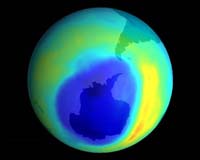
The protocol was designed to heal the gaping hole in the blanket of oxygen molecules that protects animal and plant life from the Sun's dangerous ultraviolet rays.
The atmospheric wound, which last year was estimated to span a record 29.5 million square kilometers (10.81 million square miles) over and beyond the Antarctic, is believed to be caused by slowly degrading pollutants in the air.
Ninety-five percent of targets for eliminating older CFCs (chlorofluorocarbons) by 2010 have already been met.
But some 88,000 tons of ozone-depleting substances are still produced every year, 85 percent of them in the industrialized world. And experts estimate that an additional 10,000 to 15,000 tons are produced illegally.
