
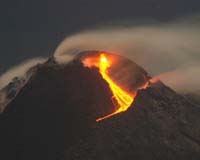
Deadly heat clouds tumbled further down the slopes of Indonesia's Mount Merapi early Monday as the volcano's activity increased ahead of a feared eruption, an official said.
"Between midnight and 6:00 am (1700 and 2300 GMT Sunday) there have been 88 outflows of heat clouds," said Jilal from the vulcanology office in Yogyakarta, a major city lying 30 kilometres (18 miles) south of the smouldering peak.
"The heat clouds have now reached a distance of two to three and a half kilometres (one to two miles) down the slope, following the course of Kali Krasak River," he said, referring to an area along the southwestern slope of the volcano in densely-populated Central Java province.
He said, however, that this was still not considered an eruption of the volcano, which was put on its highest alert status on Saturday, triggering the evacuation of thousands of people from its fertile slopes.
"It is only a sign of extraordinary activity," he said.
Blazing lava has also been oozing down the slopes of Merapi, whose name means "Mountain of Fire", but many villagers have been defying orders for a mandatory evacuation and are insisting on staying in their homes.
Officials have not released overall figures for the number of people who are considered to be in the immediate danger zone, but Vice President Yusuf Kalla said last week that about 34,000 were considered to be at risk.
Scientists have said that Merapi, a 2,914-meter (9,560-foot) peak, is likely to erupt when a new lava dome that has been rapidly forming at its peak collapses, spewing lava as well as heat clouds.
Heat clouds, known locally as "shaggy goats", consist of volcanic gases, ash and dust, and reach temperatures up to 500 degrees Celsius (930 degrees Fahrenheit). They killed 66 people during Merapi's last eruption in 1994.
