
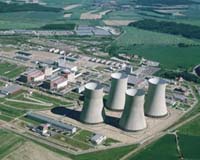
The head of the Czech Republic's nuclear power watchdog said Thursday that the frequency of leaks at the controversial Soviet-designed Temelin power plant is "unacceptable. It is not so much the seriousness of the leaks, but their frequency which is unacceptable," head of the State Authority for Nuclear Safety, Dana Drabova, said in an interview on Frekvence 1's pressclub programme.
Her comments follow Wednesday's announcement of a leak of around 1,000 litres of mildly radioactive water a day earlier, which followed a similar incident a week earlier.
The latest events have fuelled ongoing protests in neighbouring Austria, where many maintain that Temelin is unsafe.
They have also prompted more uncommon misgivings about the plant's operation at home.
Drabova advised power plant managers to look again at their operational procedures.
"I do not think this is an individual mistake but rather a procedural one and the people at Temelin should seriously think about their complex procedures," she said.
A meeting between industry minister, Martin Riman, Drabova and bosses of state controlled power company, CEZ, which owns Temelin, has been fixed for next week to review the plant's safety, ministry spokesman Tomas Bartovsky announced on Thursday.
Riman, an advocate of more nuclear power in spite of the centre-right government's ban on building new construction, said after a government meeting on Wednesday that there were only two options to explain the continuing problems plagueing Temelin.
"Either it is sloppiness or bad intent. Both are wrong, and it is necessary to investigate it and adopt measures so that it does not occur again," Riman told reporters.
The delayed admission of the first leak last week sparked angry protests in Vienna. Temelin is sited around 40 kilometres (25 miles) from the Czech-Austrian border.
The admission occurred hours after Austrian chancellor Alfred Grusenbauer agreed in Prague with his Czech counterpart, Mirk Topolanek, to set up an inter-parliamentary commission to sort out their long running row over the nuclear plant.
Source: Agence France-Presse
