
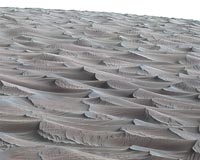
NASA's Curiosity Mars rover has begun an up-close investigation of dark sand dunes up to two stories tall.
The dunes are on the rover's trek up the lower portion of a layered Martian mountain.
The dunes close to Curiosity's current location are part of "Bagnold Dunes," a band along the northwestern flank of Mount Sharp inside Gale Crater.
Observations of this dune field from orbit show that edges of individual dunes move as much as 3 feet (1 meter) per Earth year.
The rover's planned investigations include scooping a sample of the dune material for analysis with laboratory instruments inside Curiosity.
Curiosity has been working on Mars since early August 2012.
It reached the base of Mount Sharp in 2014 after fruitfully investigating outcrops closer to its landing site and then trekking to the mountain.
The main mission objective now is to examine successively higher layers of Mount Sharp.
A view of the rippled surface of what's been informally named "High Dune" can be seen here
A wheel track exposing material beneath the surface of a sand sheet nearby can be seen here
Opportunity on west rim of Endeavour Crater within Marathon Valley
The Opportunity Mars Exploration Rover is positioned on steep, north-facing slopes for improved solar array energy production.
On Sol 4202 (Nov. 19. 2105), the robotic arm was raised so Panoramic Camera (Pancam) color images could be collected without an obstructed view of the foreground.
On Sol 4206 (Nov. 23, 2015), a small bump of less than 3 feet (a meter) was performed to position some surface targets within the work volume of the robotic arm.
Additional Flash bank readouts were performed to support the Flash memory diagnostics. On subsequent sols, both Navigation Camera (Navcam) and Pancam imagery were collected. On Sol 4211 (Nov. 28, 2015), the robotic arm was used to collect a Microscopic Imager (MI) mosaic of the surface target, named 'Pvt. Hugh McNeal.'
This was followed with the placing of the Alpha Particle X-ray Spectrometer (APXS) on the same for multi-sol integration.
As of Sol 4214 (Dec. 1, 2015), the solar array energy production was 387 watt-hours with an atmospheric opacity (Tau) of 0.544 and a solar array dust factor of 0.643.
