
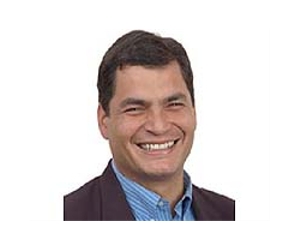
Ecuador's President Rafael Correa declared victory Saturday over rebel security forces behind a mutiny he claims sought to kill him as he urged the public to support loyal police.
Soldiers patrolled Ecuador's main cities, which gradually returned to calm. Quito's international airport and legislature were back to normal after being occupied briefly by rebel forces during the heavy gunfire and street clashes that killed eight people and left 274 wounded Thursday.
"This was a great victory for the government," Correa said in a nationally broadcast address from the presidential palace as he condemned Thursday's violence.
He insisted the rebellion was a coup attempt before the dramatic rescue of a tear-gassed Correa by loyal military and police from a hospital in Quito, where the unrest kept him holed up for half a day.
Three police colonels now in custody were due to appear before an arraignment hearing for their role in what began as a protest in Quito against cuts to bonus payments linked to seniority, before spreading to police stations in at least five of the country's 24 provinces.
The head of the national police, General Freddy Martinez, resigned.
Correa blamed supporters of Lucio Gutierrez — an ex-army colonel who was president from 2003 to 2005 — for the chaos on what he called "surely the saddest day of my entire government and one of the saddest of my life."
"Lives were lost, there were dozens of injured, Ecuadorans against Ecuadorans. How could it happen?" Correa asked after ordering three days of mourning for the victims.
But he urged the public to support the police, saying the rebellion was the work of just "a few dozen bad elements."
"Continue to support the police, because they have 42,000 members and the vast majority of them are extraordinary human beings who risk their lives every day for us all," he said, vowing to pay "good salaries" that respects police officers' dignity.
Insurgents ambushed and shot his vehicle as it left the hospital, where he had been besieged for some 12 hours amid an intense shootout, according to Correa.
The police sergeant protecting Correa was shot dead moments after soldiers and an elite police unit rushed into the hospital to rescue him, and the president said a second policeman, a soldier and a student died during the rescue operation.
Another officer was brain dead and another was left paraplegic, according to the president.
Only 600 police officers out of a force of some 40,000 took part in the uprising, according to Deputy Interior Minister Edwin Jarrin.
But sources close to the revolt said at least 2,300 officers had joined the protest.
Correa, 47, a leftist ally of Venezuelan President Hugo Chavez who has been in office since 2007, was re-elected last year to a second term as president of the South American country of 14.5 million people.
Ecuador has a history riddled with violent political upheaval.
Three of Correa's predecessors from 1996 to 2006 — including Gutierrez — were ousted before completing their terms.
The US-educated economist has taken a tough stand with foreign investors and refused to repay some foreign debt, in moves welcomed by supporters who have blamed the effects of the economic crisis on foreign liberalism.
The United States and other regional allies rushed to voice support for the beleaguered president and urged a peaceful return to calm.
Correa thanked neighbors Colombia and Peru for closing their borders during the tense standoff. The strong backing of Colombian President Juan Manuel Santos, a conservative, for Correa's leftist government signaled warming ties between the two countries.
Though a state of emergency remained in place, schools throughout Ecuador, closed due to the rebellion, were to reopen as normal on Monday, the education ministry said.
Officials did not name the three detained police colonels, but local media identified them as Manuel Rivadeneira, Julio Cesar Cueva and Marcelo Echeverria.
earlier related report
Corruption, poverty behind Ecuador crisis
Quito, Ecuador (UPI) Oct 1, 2010 –
Ecuadorian President Rafael Correa faced mounting discontent after surviving a revolt by police personnel unhappy over pay cuts that threatened to snowball into what he called an attempted "coup."
Protesters from police ranks rioted in angry reaction to austerity cuts in their pay and state benefits and held the president "hostage" for several hours at a hospital before loyal troops arrived to mount a timely rescue.
In the ensuing gunfire, casualties were reported but numbers weren't confirmed.
Correa said in a broadcast he went to the hospital for emergency treatment after he was hit by a tear-gas canister. Soon afterward, protesting police besieged the hospital and prevented him from leaving.
In an emotionally charged address to the protesters, Correa said: "If you want to kill the president, here he is. Kill him, if you want to. Kill him if you are brave enough.
"If you want to seize the barracks, if you want to leave citizens undefended, if you want to betray the mission of the police force, go ahead. But this government will do what has to be done. This president will not take a step back."
Although Correa has vowed to conduct a vigorous crackdown on police protesters, the incident capped a period of growing discontent over economic disparities and abuse of power and privilege by members of an elitist minority in the government.
The trouble started after the National Assembly passed a law Thursday that aims to introduce sharp cuts in government and state spending. Many state benefits due to be eliminated are seen by protesters as part of essential sustenance pay without which disparities will mount and hardship increase among government and state employees.
The greatest disparities are found among Ecuador's indigenous and Mestizo communities — 90 percent of an estimated 14.7 million population — and among black citizens, who comprise 3 percent of the total. The largest privileged groups are found in the 7 percent of the population that is of European origin.
Correa said the protests couldn't derail the government and urged the rioters to convey their demands through democratic means. However, many underprivileged groups say they aren't well represented in the National Assembly.
Correa rose to power in 2006 after a long period of military misrule. He also inherited massive economic problems, some caused by mismanagement, others by crashing oil and commodity prices. The El Nino impact on the economy from 1997 onward led to severe contraction of Ecuador's gross domestic product.
Correa said he would consider dissolving the National Assembly and ruling by decree until he could reassert his control on the government. However, he is likely to face opposition from within his government and in the Constitutional Court, which must approve such an option.
But he won instant support from the Union of South American Nations, which called an emergency session of heads of states in Buenos Aires. UNASUR officials said they would consider sending a high-powered delegation to Quito in expression of support to Correa.
Analysts said the unfolding crisis in Ecuador could demand more than cosmetic measures. Protesting security forces occupied several barracks and set up road blocks across the country, demanding the government abandon the austerity measures.
Despite signs there could have been a coup in the making, the military's timely support put Correa back in power though not fully in charge.
The police protest was part of wider discontent among government employees who say they work more hours for less pay than that available to private sector staff. They won support from the left wing of Correa's government that now wants the cuts deferred.
Ecuador lawmakers are nervous about adverse comparisons being drawn with Honduras, which went through a political turmoil after the country's highest court gave a green light to a coup that toppled elected President Jose Manuel Zelaya in June 2009. The reverberations from that action have prevented Honduras from returning to the international community despite a vigorous campaign.
Share This Article With Planet Earth
