
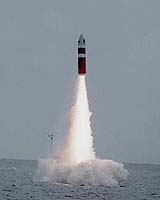
The U.S. Congress is challenging a new Pentagon plan to arm some submarine-launched ballistic missiles with conventional warheads, Arms Control Today reported in its June 2006 issue. The U.S. House of Representatives approved the defense authorization bill May 11 by a 396-31 vote; the Armed Services Committee of the U.S. Senate approved its version May 4, ACT noted.
In considering the defense authorization bill in May, both chambers raised questions about the administration's new Prompt Global Strike plan, which would substitute conventional warheads for some nuclear warheads on 24 Trident D-5 SLBMs.
Under the Bush administration's proposal, within two years, two dozen conventionally armed missiles would be dispersed among 12 submarines. That would mean each vessel would carry 22 nuclear-armed and two conventionally armed missiles. The administration has asked for $127 million for the plan for fiscal year 2007, which begins Oct. 1. 2006, the report said.
Pentagon and administration officials have said that the change is needed to give the military a non-nuclear capability for hitting "fleeting targets" with a high "regret" factor if they are not destroyed. These might include unconventional weapons threats, enemy command and control elements, and terrorists. ACT said.
However, lawmakers have questioned whether submarines with mixed loads might cause confusion for other countries about the type of missile fired and its intended target. In such a circumstance, they worry that a country might conclude that it was under U.S. nuclear attack and potentially retaliate with nuclear weapons. Russian officials, including President Vladimir Putin, have raised similar concerns, ACT noted.
"The launch of such a missile could provoke an inappropriate response from one of the nuclear powers (or) could provoke a full-scale counter-attack using strategic nuclear forces," Putin said in his annual state of the nation address May 10.
Source: United Press International
