
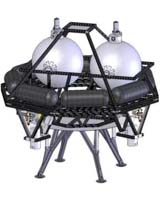
Masten Space Systems said Tuesday it has begun a "CanSats To Space" payload program intended to carry 350 gram, soda-can sized payloads into sub-orbital space and back, beginning in 2007.
Typical payloads would include science experiments such as amateur space telescopes, cellular mitosis in microgravity, and multi-spectral Earth imaging missions, the company said in a statement.
MSS said it plans to use its XA 1.0 sub-orbital rocket – the first in a planned series of 14 extreme-altitude vehicles – to launch the CanSats to altitudes of at least 100 kilometers (62 miles), where they would experience several minutes of microgravity and can be exposed to the vacuum of space.
The launch vehicle then would return to a soft landing near its takeoff point, where the CanSats would be removed and shipped back to their owners. The rocket is designed to provide power and data communications to each CanSat.
"CanSats have been flying for years on smaller rockets as part of educational programs to teach engineering and space science to high school students," explained David Masten, the company's chief executive officer. "By extending the CanSat capability into space, we are exposing K-12 students to world-class science and real-world engineering challenges."
After an introductory period, the company plans to increase the launch price to $199 per CanSat – although qualified institutions would receive an educational discount price of $129. Custom payloads that do not need the CanSat data and power services are also available in 1 kilogram increments for $250 per kilogram.
The company plans to begin launching rockets in the spring of 2008 capable of delivering larger payloads into space for approximately $25,000 each.
