
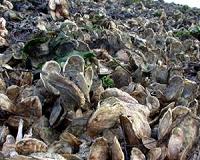
Northern Florida's Gulf Coast were once home to a large population of colossal oysters, but no more. New research suggests the once commonplace mollusks are now absent from even the most pristine stretches of Florida's coastline.
According to the latest study, published this week in the journal Biology Letters, the newest generations of Gulf Coast oysters are roughly a third smaller than their predecessors.
For the study, scientists collected oysters from some of the last remaining stretches of unspoiled coastline in northern Florida and compared them to prehistoric oyster shells recovered from dig sites near Crystal River, Florida.
"Most policy makers and conservationists working in this area are only considering the last 50 years — when we first began actively monitoring these habitats," Gregory Herbert, geoscientist at the University of South Florida, said in a news release. "Using archaeological data, our work shows that what these systems looked like 100 or 1,000 years ago matters for conservation efforts now."
Florida's Big Bend region, which comprises the eastern portion of the Florida Panhandle, is home to one of the last remaining natural oyster fisheries in the United States. Though often regarded as a pristine coastal zone, the latest research suggests the region's ecological health may be more degraded than previously thought.
"We've been altering the environment in Florida for a lot longer than the 1950's. So, if we don't look at a longer time scale, we might be missing the root causes of why fisheries and marine environments in our state are beginning to collapse," said lead researcher Stephen Hesterberg, doctoral student in integrative biology at USF.
In nature, size matters. As previous studies have shown, larger plants and animals play an outsized role in recycling nutrients and boosting ecological health. In the Big Bend region, larger oysters offer superior water filtration services and great reproductive success than their smaller peers.
Oyster reefs with a greater abundance of offspring can recover more quickly from mass mortality events. Without the improved filtration services of colossal oysters, downstream estuary habitats are more likely to feature muddier water, stunting the photosynthesis and growth of sea grasses.
Researchers used isotopic geochemistry to study the biological changes in modern oysters. Their analysis showed modern oysters are just physically shorter, they're also living shorter lives and growing more slowly.
Authors of the new study hope their findings will help conservationists develop better oyster habitat management strategies. If wildlife managers can find ways to improve the ecological health of Florida's Big Bend region, it's possible the colossal oysters will return.
Cuttlefish opt for lighter lunch when shrimp is on the dinner menu
Washington DC (UPI) Feb 05, 2020 –
When cuttlefish know their favorite food, shrimp, is on the dinner menu, they eat fewer crabs throughout the day, according to a new study.
The findings, published Wednesday in the journal Biology Letters, offer proof that cuttlefish can learn from their experiences, recognizing feeding patterns, and adjust their eating habits accordingly.
"It was surprising to see how quickly the cuttlefish adapted their eating behavior — in only a few days they learned whether there was likely to be shrimp in the evening or not," Pauline Billard, a doctoral student in the psychology department at the University of Cambridge, said in a news release. "This is a very complex behavior and is only possible because they have a sophisticated brain."
Cuttlefish alternate between two different feeding modes, selective or opportunistic. In lab experiments, scientists regularly provided specimens of European common cuttlefish, Sepia officinalis, with a single shrimp each evening.
The cuttlefish quickly picked up on the pattern and began eating fewer crabs during the day. When the cuttlefish knew they could count on a shrimp dinner, they were more selective.
When researchers only provided shrimp sporadically, the cuttlefish were more opportunistic, eating more crabs throughout the day.
Though cuttlefish are generalist eaters, they also show strong food preferences. Researchers were able to determine the cuttlefish's favorite food by placing crab and shrimp at equal distances from the test specimens. The cuttlefish consistently consumed the shrimp first.
Like their cephalopod relatives, cuttlefish are born with an already well-developed central nervous system, allowing them to begin learning from their experiences and recognizing patterns at a young age. Scientists suspect the cognitive abilities of the cuttlefish allow the animals to adapt to changing environmental conditions.
Though cephalopods, a group of mollusks that include octopi and squid, diverged from vertebrates some 550 million years ago, their central nervous systems are organized similarly.
"This flexible foraging strategy shows that cuttlefish can adapt quickly to changes in their environment using previous experience," said study leader Nicola Clayton, professor of psychology at Cambridge's Department of Psychology. "This discovery could provide a valuable insight into the evolutionary origins of such complex cognitive ability."
