
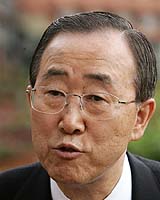
United Nations chief Ban Ki-moon on Monday warned that climate change had driven the world to a "critical stage," directly affecting human health and the environment. "The world has reached a critical stage … despite our best intentions, the degradation of the global environment continues unabated," Ban said in a message to the UN Environment Programme (UNEP) conference in Nairobi.
Amid concerted calls for global action to stem further damage, Ban vowed to make the divisive climate issue "one of my priorities as secretary general."
"The effects of climate change are being felt across the globe, resulting in a decline in human health and loss in ecosystems," he warned in the message, read out by deputy UNEP chief Shafqat Kakakhel.
Last week, climate scientists concluded in a hard-hitting report that global warming was "unequivocal" and that it was being spurred by a raft of human activity.
The Intergovernmental Panel on Climate Change (IPCC) report, its first for six years, said fossil fuel pollution would raise temperatures this century, worsen floods, droughts and hurricanes, melt polar ice and damage the climate system for a thousand years to come.
All this will be the result of an accumulation of heat-trapping gases in the atmosphere that block the Sun's heat from radiating back to Earth.
Kenyan President Mwai Kibaki urged some of the developed countries outside the UN climate treaty, known as the Kyoto Protocol, to take steps that could reduce emissions of greenhouse gases that are blamed for rapid climate change.
"The negative effects of climate change in developing countries make a direct a impact on development," Kibaki told environment ministers attending the conference.
"We urge our friends from the developed world to join hands with us from developing countries to bridge the ever-increasing gap … to take economic development to greater heights to benefit the environment."
Despite calls for action, the United States — the world's biggest polluter — remains outside the Kyoto protocol, which expires by 2012, but is party to the United Nations Framework Convention on Climate Change (UNFCCC).
But Washington, as well as ally Australia, says emerging economies like China and India must sign up to an international agreement to curb greenhouse gases before they will do likewise, a position that has sparked a stalemate.
The rapid increase in global trade has also been blamed for the rise in greenhouse gas emissions, and World Trade Organisation chief Pascal Lamy told the conference that his organisation "stands ready to act."
"We have received a serious warning on climate change. It is no more an option to act — this must be the cornerstone approach to globalisation," Lamy said. "The WTO stands ready to act. Globalisation requires careful management. Trade must play its part in sustainable development."
Source: Agence France-Presse
