
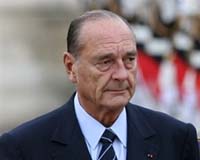
French President Jacques Chirac strode energetically into his last formal European summit on Thursday championing the role of nuclear power in the fight against climate change. Chirac arrived in Brussels for the meeting three days ahead of a widely expected announcement that he won't put his hat into the ring for a third term in office.
His office announced on Thursday that the 74-year-old Chirac will make his intentions known in a televised address to the nation at 8:00 pm (1900 GMT) on Sunday evening, putting an end to weeks of mild suspense.
With the flame going out on his 12-year tenure in the Elysee Palace, the French leader was warmly met here by Europe's new star, German Chancellor Angela Merkel, who is chairing the two-day summit.
His fellow leaders made little comment on Chirac's impending departure, as they entered the large, impersonal Justus Lipsius building, HQ of the European Council.
That was partly because Chirac's long European goodbye will enjoy an encore at the celebrations in Berlin on March 25 to mark the 50th anniversary of the EU's founding Treaty of Rome.
By then he should have officially adopted the role of outgoing leader, ahead of French presidential elections in April and May.
Only Luxembourg Prime Minister Jean-Claude Juncker, whose close ties with Chirac extend to opposing the war in Iraq, openly hailed the French leader.
"Chirac, like his predecessors, has always tried to find a compromise on the main European questions," he told reporters.
"He has very often been among those who have really pushed for a more integrated Europe," he added. "Sometimes we disagreed, but this is a man whom I am happy to have known."
The French President arrived in Brussels with, as usual, the firm intention of making the French voice heard amid the Euro cacophony.
This time he went into battle to have nuclear power, which accounts for 85 percent of French energy production, recognised by the 27 EU member states as a clean, green, non-carbon emitting fuel.
That stance could wipe the welcoming smile of Merkel's face. Official German policy is to phase out nuclear power altogether.
While the member states were expected to agree on a reduction of at least 20 percent of greenhouse gases by 2020, from 1990 levels, they remain split over atomic power with the anti-nuclear camp championed by Austria and Ireland and the Green group in the European parliament.
Some environmentalists accuse France of a kind of environmental blackmail, by promising not to block a related proposal to boost renewable sources to 20 percent of energy production in return for a more nuclear-friendly summit agreement.
It's a fitting nuclear end to 12 years in office. Soon after Chirac was elected in 1995, the new leader decided to resume nuclear tests in the south Pacific.
Source: Agence France-Presse
