
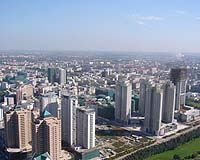
A senior Chinese official has warned architects and builders of the risk of earthquakes as they continue racing to erect ever-higher skyscrapers, according to a government website Wednesday. In a speech at a national meeting of construction experts last month, Deputy Minister of Construction Huang Wei said many steel or steel-reinforced concrete structures were not designed to withstand earthquakes.
Huang said more research was needed on quake-proof designs for buildings over 100 meters (330 feet) high.
China's booming economy and a penchant for flaunting wealth has sparked a competition among cities to build the tallest building in the country, in the region or even in the world.
The latest competitors include Shanghai's World Financial Center, to stand 492 meters tall on completion, and the new television transmitter tower in Guangzhou with a designed height of 600 meters.
But most of these skyscrapers would be located in areas vulnerable to strong earthquakes, Huang warned.
Huang also expressed concern over an increasing number of buildings designed by foreign architects, many of whom lacked experience in designing quake-resistant structures.
He warned that some of the buildings with unusual structures designed by these foreign architects may risk being seriously damaged in an earthquake.
They included the 230-metre-tall headquarters of China Central Television, made up of two inverted L-shaped towers and designed by Dutch architect Rem Koolhaas, he said.
"Many unusually-designed buildings were seriously damaged in earthquakes in Japan's Kobe and Taiwan. We need to be alerted to this," said Huang.
Most Chinese people embrace skyscrapers as symbols of progress and advanced technology.
China last week marked the earthquake in Tangshan city, which was razed by the quake measuring 7.8 on the Richter scale on July 28, 1976, claiming more than 240,000 lives.
An earthquake measuring 5.1 on the Richter scale rocked Wen'an county in Hebei province on July 4. The tremor was felt in Beijing.
Source: Agence France-Presse
